Tuesday, February 1, 2022

Interview with Bradley Lomax, Beetle Percussion

Bradley Lomax got his start in drumming as a child. Participating in school music programs and drum corps, majoring in music in college and growing a massive set of drumming chops, like many who read this blog. Along the way, he became aware of the impact that our lives have on the environment, and how the environment has responded to our impact; and at that point he became a champion of sustainability in all things. Because of that commitment he makes each Beetle Percussion product himself, using as many recycled or repurposed components as he possibly can, and his practice pads are some of the most beautiful in the world.

This makes him something of a rarity in the drum industry, and someone I’ve been dying to chat with for almost a year.

Here’s our interview.

BH: How did you go from playing to making drum equipment?

BL: I got really serious about drumming in high school, and after high school I marched a few seasons of drum corps (first with the Sky Ruders and then with Pioneer). My sophomore year in high school, I got a job working for Bill Cardwell at C&C Drum Shop, where I taught private lessons and in my spare time I watched and learned about the craft of drum making.

I got so into making stuff — learning at C&C and also taking jobs in construction — that eventually I left college and went into teaching lessons and doing construction pretty much full-time.

BH: What was your inspiration for starting Beetle Percussion?

BL: When I was growing up, my parents would take me on vacations in Colorado, and I loved it. Everything was so green and beautiful and I loved going back again and again. After I left school, my parents went back to our favorite vacation place and returned to tell me that beetles were destroying the trees there, eating them to death.

Global warming was forcing the Beetles to turn to these trees for a primary food source in increasingly huge numbers, and whole forests were being destroyed. The whole area was transitioning into some kind of arid desert because the trees were dying. I was horrified.

Since I work with wood, I decided to create something that would use the wood from these trees  and I hit upon the idea of practice pads. I called the US Forest Service to ask about getting some of that wood, because they had to clear it out of there before it became fuel for a forest fire; and they referred me to a bunch of mills who were taking the reclaimed timber and turning it into furniture and stuff.

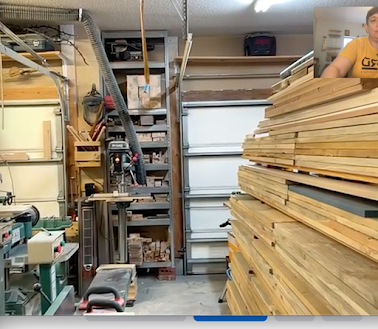
I established a relationship with one of those mills, who brings me some of the reclaimed lumber; they deliver it on pallets right at my workshop.

At first, I tried making pads out of natural rounds, with the bark and everything, because I thought they’d look cool. But working with wood that way is really, really difficult and trying to force it into shape just wasn’t working. So ultimately, I had to set up a serious wood shop with all sorts of planing saws and things, learning how to treat the rough wood like potential furniture. After that, my vision for the pads became easier to clarify. Basically, I make practice pads like furniture, and that’s why they look so finished and smooth. There really isn’t any other way to make them turn out so good.



We source recycled car tire rubber from a company that supplies  it to flooring manufacturers. Because it used to be car tires, we sometimes have to pull out bits of metal — old nails, sidewall material, and stuff — so that we can work with just the rubber and mold it into a playing surface.

BH: What’s your target market? I assume it’s more connected to the marching arts, because your pads are fairly hard. I don’t currently own a Beetle pad but I’ve tried a few and that’s my takeaway.

BL: Yes, the overwhelming majority of people who buy our pads are marching band and corps members who want a pad that feels more like a marching drum head. I’d say almost 90 per cent of our customers fall into this category.

What’s great is that college instructor are excited by the “green” aspect of our pads, and they hype that to the kids and get them thinking about it, and suddenly it’s cool to play a “green” pad.

As to why the pads feel harder, a lot of that is the wood that’s used. Ash is a very dense, hard wood and that makes it great for building a marching pad around; pine, on the other hand, is a softer wood and will give you a response that’s a little closer to a concert or all-around pad.

BH: What about different thicknesses of rubber? Would that affect the response?

BL: It would, but only to a point. Thicker than a quarter-inch and it gets kind of dead-feeling. That’s why we stick with 3/16” and quarter-inch thicknesses on our pads — they just give the best response and feel.
And honestly, we have to respond to what our customers tell us they want. Since they’re mostly marching drummers, we have to give them a pad that responds the way a Kevlar-headed drum would.

BH: Fair enough.
In addition to your commitment to using reclaimed timber and recycled rubber, how else do you promote sustainability at Beetle?

BL: For every item sold, a tree seedling is planted to replace the tree that was destroyed by the beetles. We partner with forest management agencies in Colorado to accomplish this. Removing harmful material and planting new trees helps to stabilize the watershed, restores wildlife habitat and promotes regrowth.

BH: Now, for the hard questions: You make your pads as sustainability as possible. But the carbon footprint involved in that process, from gathering raw materials to shipping out finished pads, cannot be denied. How do you weigh this reality against your efforts? And how wide-angle can you go in your vision before it drives you crazy?

BL: (laughs) Yeah, it’s true. I plant trees, I use reclaimed and recycled materials, and I know it only goes so far. The truth is that none of us can control everything. We can only control what each of us can control, right where we are. It’s a double-edged sword and I do what I can. When my HOA lets me put solar panels on my roof, when everything can be delivered without relying on fossil fuels, that will be wonderful. In the meantime, just getting the kids to be more aware of the need for a more sustainable way of life is a win. We plant seeds and they carry them forward.

I can only do the best that I can do. And hope that enough people will notice and start to pay attention to the places in their own lives that can be made and done more sustainably.

BH: Well, you get no argument from me. I LOVE that there’s a company promoting sustainability and I look forward to more people taking notice and paying attention.


Saturday, January 29, 2022

Drum redoo: practice pad platform

For over a year, this homemade platform from scrap wood and a torn drum mute served as a great base for my practice pad.
Tonight, I added a layer of cork contact paper, and now I have an amazing practice pad that simulates the feel of my floor toms.


cross section of layers


UPDATE! I added an old angle bar to make a "guard rail" so I can tilt the platform enough for traditional grip. Works great!


Sunday, January 9, 2022

DIY Drummer: New Vintage -- Bower replica pads, small batch

I was asked by Mark Beecher (president of NARD and a brilliant drummer and drum historian) if I’d make up a few replicas of the first patented practice pad, designed by Harry Bower in 1919 and patented in 1921.

Other pads were in existence, and offered by various makers throughout the early years of the twentieth century. But the concept of “mass”production in the 1910s was at best, in the hundreds, not in the tens of thousands large companies produce today.

Bower’s design was simple, and by modern standards downright primitive. A wooden platform, a layer of wool, covered by a thin layer of tanned leather, all bound up by string or a shoelace. I. Still trying to learn what the retail price was but I can’t imagine it was more than a dollar or two.

After the patent was awarded, Bower contracted with another fellow to “mass” produce the pads and distribute them. I’m still researching the success of the enterprise — and the longevity. 

Anyway, here’s the pad.


I glued a copy of the original label to the underside.


And did this over again five times. Four of the pads are available at $50 each including shipping in USA, and my original prototype is available at $25 including shipping in USA. 
(I’ll keep the fifth pad for myself.)

It’s not a modern pad. There’s just enough response that you can use your wrists and fingers to pull out decent strokes from the leather. If you want effortless rebound, buy a RealFeel.
But if you want to try a pad that your grandparents or great-grandparents might have practiced on, try this. It will give you new respect for the drummers of an earlier age and help you appreciate how far we’ve come.

(Video, playing my finished pad according to the instructions on the label)


Tuesday, January 4, 2022

In praise of 2B sticks

I was recently invited to join yet another Facebook group, this one devoted to "Boutique and Collectible Drumsticks," where I've been getting an education in the range and scope of high-zoot, hand-turned sticks.

Since most of what the other members own and use is beyond my paygrade, I decided to stick with my focus of vintage sticks in the sizes I normally use. It's a cheaper option and in most cases, a more attainable one. It also allows me to start in a more familiar landscape; most of the fancy sticks are made and enjoyed by folks in either the symphonic or ancient drum corps categories, neither of which I inhabit.

So here I am with a bag full of sticks in the most familiar and ordinary size of 2B.

This is the size most beginning drum students learn on (except for me -- my hands were too small at age ten to manage the size, so my 5th grade band director gave me a pair of 5A's instead. In retrospect it may not have been the best choice but my hands eventually grew to manage large sizes and, well, here we are.) It's a good all-around stick for school use and remains my personal favorite for ordinary concert, rudimental and pad work.

(Before we continue, feel free to read this excellent overview of how and why drum sticks sizes came about.)

As with all things manufactured, there's a fair amount of variety within a given size designation. Below is a spread of drumsticks in my collection, all labeled "2B" and all slightly different from each other.

Below, Left to Right: Vater 2B, Vater "Classics" 2B, KK 2B (made in Russia), Vic Firth American Sound 2B (no longer made), Speedex 2B (1960s), Fibes 2B "Band" and 2B "Power" (both circa 1978 or so), Carroll 2B (1960s, Mercury 2B (1950s) and Slingerland Haskell Harr signature 2B (early 1960s, nylon tip)


The variety found in this small group illustrates the lack of standardization, which remains with us today. Up close, you can see even more variety, just by looking at the tip and taper of each pair:


For example, the Fibes sticks are freakishly different in tip and taper from the rest. (I admit that I loved playing with "Power" 2Bs in high school band, and when I found a pair recently I HAD to have them again.) Otherwise, with the exception of The Vic Firth American Sound's round tip, everything else has some variation of the rounded or acorn tip found commonly in this designation.

I enjoy comparing and contrasting the response and sound of different sticks within a size designation, but for most of my daily pad work, I always end up returning to the Vater 2B (Far left). The balance and feel just work well for my hands at this point.

When looking for a pair of sticks I'm going to play a lot, I always want to check for straightness, weight and pitch-matching.
When I was kid, this meant going to the stick display and trying every pair of sticks in a brand and size designation until I found a pair or two that checked all the boxes.
Today, most of the major manufacturers claim to do this as part of their quality controls before the sticks leave the factory; its been my experience that the top three -- Vic Firth, Promark and Vater -- do a pretty good job of this, and I tend to trust their judgment most of the time.
However, it helps that if I order their sticks through the mail and am not satisfied, I can send them back for replacement. (Vater is especially great about this in my limited experience.)

With the advent of custom sticks, it has become possible to establish a relationship with a small maker over time, and then bring to them an older mass-produced stick for their suggestions and improvement, making for a truly custom -- and expensive -- product. Again, that's too rich for my blood, but I'm glad to know the option exists.

Finally, Here's an example of a "mass-produced" pair of sticks from the 1960s, before strict quality controls were in place:

Speedex 2B. Note the difference in length --


-- and in taper and tip shape as well.

This would be far less likely to happen today. But I keep this pair on hand to remind me what things were like and to see how far we've come.

Today it is possible to find even a cheap pair of drumsticks with tighter tolerances and quality control than "better" sticks of my childhood, so anyone can find a decent pair of sticks and get started on their next drumming adventure.

Carry on.
Happy chopping!


Tuesday, November 23, 2021

DIY Drummer: Odds-n-Ends -- repurposing, refurbishing

 On my way to swapping out for a smaller bass drum for my West Craft kit, I had an idea.
I asked Kaleb if he'd be interested in taking on a small side project in addition to refurbishing my bass drum. "No rush," I said, "I just wonder what it would look like if you gave this the West Craft treatment." Kaleb was intrigued and took home one of three vintage Ludwig practice pads I had.
All I told him was, "Do it up in shades of blue, and don't worry about the rubber because I'll clean that myself when you're all done."

Less than two hours later, he sent me three photos. He was intrigued.


When I get the finished pad I'll be sure to share it here.

Also, I received in a batch of sticks a mallets an extra, unmatched pair of vintage Ludwig timpani mallets. Both had badly degraded felts, and the heads had been glued to the shafts so removing them for replacement would be risky. They weren't so far apart in size and shape that I couldn't do SOMEthing with them, though.
So today, I decided to turn them into multipurpose mallets. I wrapped the harder of the two mallets with a few turns of the soft wool yarn to help equalize the hardness and size of the heads a little more. Then wrapped both heads vertically in rotating loops, the way yarn mallets are traditionally wound. I had taught myself how to do this in college, from a little booklet on mallet repair (I also used to recover my timpani mallets with new felt, using the instructions from the same booklet).

These mallets turned out to be a little on the big side, but that's okay. I figure they can be used for soft rolls on timpani, drumkit toms and maybe even some cymbals.


The yarn I chose was very thick ply, designed for use in scarves, potholders, hats and other thick things. It turned out to be quite useful for this application, because it's thick and soft.
Finally, To keep a couple hairline cracks from growing, I decided to wrap the wooden shafts in white stick tape. I added a second layer in the handle area to help improve the balance a little.

I'm pleased at how it turned out.

I have a couple new pads coming my way soon, and I look forward to putting through their paces and reporting about them here.

A reminder: If you or someone you know is connected to a company that makes pads, or that has historical documentation about pads the company made long ago, please let me know! I am always looking for new pads to test and review here; if you work with a company that is willing to send me a sample to test, that would be great. I don't have infinite funding to spend on this so I appreciate it when companies are willing to send me a pad. I also seek historical documentation about the design and development of practice pads, especially prior to 1940. If you can help, please let me know by reaching out to me through Facebook.

Thanks and happy drumming.

Monday, November 15, 2021

More pad restoration: know what to look for, and keep it out of the landfill

 So this week I scored a wonderful selection of old pads and hardware.

The seller needed to clear it out quickly, accepted my below-asking offer and was willing to ship for free.

Granted, these pads will need some cleaning up, but when I’m done, they’ll be as fun to pound on as when they were new, and the hardware will help complete a few drum kits in the neighborhood.

When you look for used pads to clean up and reuse, you have to know what to look for.

AND you have to be willing to put in the time and work to rescue them.

The rubber pads will need some cleaning, and some real elbow grease to bring them back to useful life.  The tunable Remo pads just need cleaning up and fresh replacement heads.

Soon after I take delivery on this lot, several drummers will have great pads to practice on, and I will have kept all this stuff out of the landfill.

THIS is what sustainability is about. Find old, beat-up stuff, fix it up and clean it up, and prepare it for a second life with a new owner.

What I’m saying here won’t make many manufacturers happy; for them, it’s about tying custom to buy new stuff regularly. But for kids on a budget, for nonprofit youth programs on a budget, for your friend down the street who’s preparing to audition for a corps and needs a more durable practice pad, sustainability is EXACTLY what we should promote within the drumming world.

End of sermon. Happy Drumming!


Thursday, October 28, 2021

Future Vintage: Vic Firth IMS10 drum sticks

 Sometime in the early to mid 2000's, Vic Firth released a stick called the IMS10. Designed in partnership with notable DCI drum instructor Brian S. Mason for the growing indoor percussion activity, it was smaller than most marching sticks used outdoors and featured an elongated acorn tip. Presumably, it was not a big seller at the time, because after several years Vic Firth stopped making them.

I wish they hadn't. It's a GREAT stick.

It is smaller, but no overly so; and it is one of the best balanced, most comfortable sticks I've ever used for marching. I also like it for some concert percussion situations where a field drum and/or slightly heavier stick is called for. And it's a great rudimental stick as well.

The first generation were made with black paint, Mason's signature and wood tips.


Later, an unpainted version was released, without a signature, in both wood and nylon tipped versions. It was a little bit lighter than the original, perhaps because it was felt they'd be a better seller in a lighter weight for a wider variety of uses.


Today, I have a couple pairs that I've held in reserve. One pair is on my wall display rack, and the other pair is in my stickbag, taped up and used in my community marching band.

It's a fantastic stick. Some folks remember playing with these back in the day and are looking for them again. I recently scored a bundle of 15 pairs of these, New Old Stock from a music store that's closing its doors. I'm keeping another pair for myself and I've sold off some of the others. (I have a few pairs left as of this writing; hit me up on FB if you want a pair.)

If there's anyone out with some kind of pull at Vic Firth, maybe give a shout out that these sticks still have a fan base and ought to be brought back into production. Because right now they're hard to find and at some point they'll be gone, Let's keep these from becoming truly vintage one day.

Happy chopping!