Saturday, December 21, 2019

when drumming is therapy: drummitation (drum meditation)

This week, plans were upturned when we got the news that my father-in-law had entered into home hospice care. His cancer treatments have been unsuccessful in stemming the growth of the disease and he is preparing for the end of his life, which we're told could come in weeks or even less time.
We leave for California on Monday to spend the remaining time with family.

As you can imagine, this is a stressful time as we rush to make travel arrangements, figure out pet care, and cancel holiday plans.

And when things get intense and our nerves get frazzled, as has happened repeatedly in the last few days, Sweetie advises me to go into the other room and drum.

Yes, really.

Drumming is something I've often done throughout my life to relieve stress. Today has been especially difficult as we juggle various details of our need to rush to be with family. So more than once, I've retreated to the back room in our little house and chopped out.

In the morning it's been as simple as playing slow and steady eighth notes to a metronome, gradually increasing speed and continuing until my hands get tense, then backing off of that a little and hanging out at the fastest comfortable tempo for several minutes. This is usually enough to calm me down and clear my head.

If after that I feel a desire to chop out on random stuff I can do that too, like in the videos below.
This "drummitation," as I like to call it, has helped repeatedly in my quest for calm during tense times. I recommend it highly.

Numerous studies have shown that repeated drumming can calm the fight-or-flight response in the brain, can improve blood flow and lower blood pressure, and can help to relieve stress in much the same way that gentle exercise does. I must have known all that instinctively before I'd ever read about it, when I was a kid; my childhood was filled with a great deal of stress and drumming was something I could always do to calm down. About eighteen months ago I began to turn it into a morning meditative practice, with a metronome and a rubber pad (to avoid disturbing Sweetie, who worked in the dining room and asked me not to meditate on an actual drum while she was home).
It has become a regular part of my meditative practice and a cherished part of how I wake up and come to "full density" in the morning.

Wherever your drumming takes you this season, I hope it's enjoyable and fulfilling.
Happy Holidays.


Sunday, November 3, 2019

wilcoxon rudimental challenge 2019


No photo description available.A tip o' the hat to Kevin Lehman for setting up the Wilcoxon Rudimental Challenge on Facebook.
Rudimental drummers from around the world are posting videos of themselves playing one of the solos from the seminal collection "All-American Drummer: 150 Rudimental Solos" by Charley Wilcoxon.

This book is filled with intermediate to advanced rudimental solos that assume a knowledge of at least the first thirteen traditional drum rudiments (based on the 26 original rudiments as designated by the founders of NARD back in the 1930s -- NOT the 40 rudiments designated much later by Percussive Arts Society).

I wasn't challenged to join the group by another drummer, so I worked up a solo of my choice, joined the group and tossed my hat in the ring. It took several days to work up the solo to a reasonable temp, and another hour to play it through several times with the repeat without screwing up, before I felt ready to make a video of myself. Then it took another ten takes or so to get a clean take from start to finish. Even then, it was hairy going, and I could've done the end of the repeat better; but it was fun to challenge myself like this.

I'll totally do it again very soon.

(Here's my attempt for posterity, played in the new drum which still needs some gradual fine-tuning and tightening over the next week or so. NOTE: I chose to play the rolls timed and wide open, rather than to rush the drags and risk blowing the timing and tempo. It's an individual choice, and up to each drummer what to do with the rolls.)

Enjoy! And if you think you'd like to give this a try, contact Kevin Lehman at the Facebook group to learn more. The group has grown rapidly so that there are now a few repeats of solos but that's probably not a huge deal if most of the solos in the book are spoken for. Check with Kevin.

If you don't own this book, it's available at multiple book stores, including Powell's Books in Portland, and also from Reverb online.

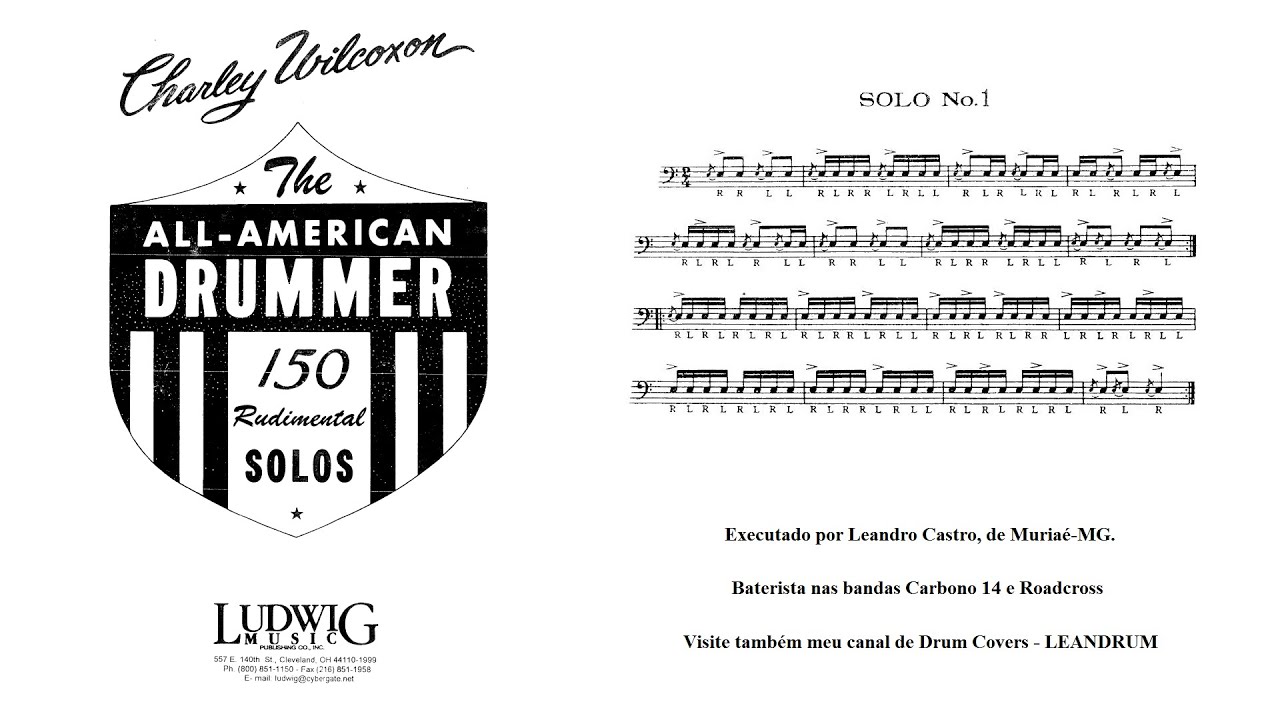
Here's Solo No. 1 if you're so inclined to dive into the collection. I think it's worth owning a copy of the whole collection. Happy drumming!


 https://i.ytimg.com/vi/j6ZWxpJw1S8/maxresdefault.jpg


Friday, October 4, 2019

play outside

During this week, my partner and I are both serving congregations as cantorial soloists.
But we're serving different communities and have to practice different music and/or settings.
In our very small house, that sometimes means we take turns practicing and the other goes somewhere else for an hour ot two to give each other some space and time alone in the house.

It was my turn the other day, so I took sticks and a pad over to the park and chopped out a little.


Since hanging out on the Marching Percussion Group on Facebook, I've learned quite a lot and have gotten exercises, advice and encouragement from some very experienced drummers, including a few rockstars who marched in drum corps in the 1960s and early 70s. Since my drumming in town is limited to to the community band I play with now and then, where the musical challenges are more ensemble based than rudimentally based, My rudimental chops are developing slowly after my eight-year hiatus in the late 90s-early 2000s; and I am slowly making up for some of the lost time.

My flams STILL suck, mostly because of my arthritic left hand; and I can play more easily only after soaking my hands in hot water in the mornings before I play. But my rolls and diddle exercises are smoother now, and I enjoy playing more than I did when I started back up again.

If time and logistics permitted, I would love to find a rudimentally-based drumline to chop out with, even if just for fun once a month.

Wednesday, September 18, 2019

Undergrads don't get published in peer-review journals!

I wanted to let readers know that a copy of my article, "Percussion Instruments in 16th Century Ottoman Empire" is now available on scribd.com:

https://www.scribd.com/document/426438540/Percussion-Instruments-in-16th-Century-Ottoman-Empire
 
I originally wrote this as a term paper for a course in Ottoman History that I'd been invited to take by Dr. Jon Mandaville, my Middle East Studies Certificate advisor and a great guy. Since it was a graduate course, he allowed me to take it as a 499 and assigned a term paper that was, at 25 pages typed, half the length of what his grad students in history were required to turn in.
I had never written so thorough or long a paper in my life, with footnotes and everything.

When I turned it in, I also had to give the class an oral presentation that summarized my research. That part was fun, because I basically wheeled a large cart from the band room, piled high with percussion instruments, into the History department and gave a talk with demonstrations for the class, who were all grad students. It was a difficult and ultimately fun assignment.

During my research, the editor of Percussive Notes, the quarterly journal of the Percussive Arts Society, responded to my request for assistance (he said he couldn't really offer any as the topic was not in his wheelhouse) and invited me to submit my paper when it was finished. I promised him I would, but only if I got an A on the paper.

I got an A-minus. The editor urged me to send it.

So I sent him the paper. Since I could not afford membership in the PAS at the time (and since I was only a term away from graduating and wouldn't need a PAS membership in Cantorial school), I asked if he would send me two copies of the issue when it came out. One would be for my advisor, and the other for my father.

About two months before graduation, I got my copies in the mail, and brought one to my advisor as my way of thanking him for challenging me.

He hadn't known that I was submitting my paper anywhere. He was thrilled.
He cut the article out of the magazine and posted it outside his office, with a sticky-note that said, "written by PSU's Beth Hamon for HST 499" -- and circled my photo with a yellow highlight pen.

His graduate assistant Aaron, who'd taken the class with me and had submitted a 50-page paper (on his chosen topic, trade routes throughout the Ottoman Empire) was astonished, and more than a little jealous.
When I asked why he was so shocked, he told me, "Because Percussive Notes is a peer-review journal!" Seeing my confusion, he added,  "Undergrads don't get published in peer-review journals!"
To add insult to injury, I had to ask him what a peer-review journal was. I'd never heard the term before.
Aaron didn't know whether to hate me or take me out for a beer. He ultimately chose the latter, and urged me to keep writing.

My father was also very proud (he didn't know what a peer-review journal was, either, since he'd never gone to college). He told me to keep the second copy of the magazine for my files.
I'm glad I did.

In order to get free content from scribd.com I had to buy a membership, or share something I'd written in exchange.

Enjoy reading it.

Monday, September 16, 2019

Shuffling along with LIDO (vintage sticks)


No photo description available. 
A recent find, these Lido 2B drumsticks date from probably the early 1960s.
                                            No photo description available. 
       
No photo description available.
No photo description available.Lido was a brand used on drums and sticks made in Japan during the late 1950s/early 1960s. But the catch -- and what makes it harder to research -- is the fact that one Japanese plant manufactured sticks and drums for Lido and a host of other budget-level brands, simply stamping the product with whatever brand was ordered.

For a model 2B the sticks feel rather lightweight, but the grain still suggests some kind of hickory.
There's a lovely patina to them, and only a tiny bit of wood has been worn away from one of the tips. They're decently balanced as a pair, and they play nicely on my vintage Slingerland pad.
They feel more like a large-tipped orchestral stick than a concert band stick.
Eventually, Lido and a few other budget brands from this Japanese plant would be subsumed into the Pearl Drum Company.


Sunday, September 15, 2019

happy hands

As I've explained here before, I have some kind of arthritis, which may or may not be related to also having auto-immune issues. On difficult mornings, my hands are stiff and sore. On better mornings, like today, they're still stiff and my left middle finger still locks up but they don't hurt nearly as much.
So when I have a good hand day, I play whatever I can.

Today it's an old cadence I taught back in the Bronze Age of my pageantry arts teaching career, called El Mondo Groovo (drum cadences aren't generally known for their thoughtful titles). I also tossed in a basic "halt" at the end.

Sticks: Vic Firth, Jeff Queen solo model)
Pad: Vic Firth Slimpad


Wednesday, August 28, 2019

Vintage Drums vs. Vintage Pads: challenges for collectors

I've been collecting vintage drum pads for awhile, over a decade. In my efforts to learn as much as I can about them, I've taken it upon myself to research each pad that comes into my humble little collection. Collectors of vintage drums do this too; in fact, there are a number of books published with histories of each major drum company and photos of significant drum models throughout their histories. Books are now available for Ludwig, Slingerland, Gretsch, and many more.

These histories seldom, if ever, offer photos of practice pads. This is largely because Pads hold little interest for a collector who has room to store and display full-sized drums -- and drum kits -- at home.

In fact, I am the only person I know of who has made it a point to focus on pads and, to a lesser extent, vintage sticks.

The primary reason most collectors focus on drums is that they're sexy. Like vintage cars, each make and model from a certain age has its own distinctive markings and style. They look as beautiful as they sound. And if you find one in poor condition, it's a fun challenge to try and restore it, just like a classic car. Parts are out there for the swapping.

A secondary, but no less important reason for the lack of attention given to pads, is that, unlike many drums, they are not date-stamped or utilize a serial number in the manufacture process. Taking it farther, a number of manufacturers had their pads all made by one or two factories, and simply embossed with the appropriate brand name and logo. Practice pads from the 1940s through 70s were a low-profit item, cheap and easy to make and sell, and they were never intended to be sexy. A practice pad was, and is, a simple tool that aids in drummer development.
With one or two factories cranking out cheap practice pads for mutliple companies, it was common to see the exact same photos or illustrations of a pad design in the catalogs of multiple drum companies.

1. Slingerland, circa 1938. Note the design of the bottom three pads in the photo.


2. George Way, circa 1950. Note the design of the top three pads shown here. There is virtually NO difference in design or construction of these pads from those in the Slingerland catalog of 13 years earlier. That's because there was no real change in standard pad designs during these years.


3. Here's another example. Ludwig Drum catalog, circa 1957. Note the standard rubber-on-wood pad designs shown along the top of the page. Now look at the all-rubber Porto-Pad at the far upper left, and the rubber-on-metal design just to the right of it. The "All-Metal" pad is a design that was adapted from one appearing in the 1950 George Way catalog (which had a round rubber pad instead of a square one). The rubber pad is a design first marketed by the WFL Drum Company, which was absorbed into Ludwig during a consolidation in the 1950's.


The upshot of these examples is that, with so many manufacturers offering practice pads of similar (if not identical) size and design, and with the buyout and consolidation of drum companies throughout this "golden" age of rudimental drumming, it's very hard to determine whose design came first. It's even harder to determine the exact age of a vintage pad because along with this reality, there were no serial numbers applied to pads.

The only pads I've been able to approximate an age on are two with unusual identifying characteristics and/or short shelf lives. The first was my Slingerland Radio King practice pad, which dates from the late 1940's. I was able to date this because of the unusual badge design, which was only used on Radio King practice pads for a few years after WWII and went out of production by 1950-51. The other pad is my recently-acquired Timpette, which was easy to date because of its very limited production run in the late 40s -- information which I was able to research on Google Patents.

If you collect drums and have not yet used Google Patents to aid in your historical research, I strongly urge you to check it out. Though it's generally more useful for researching innovations in design rather than researching by model and year, this site has been invaluable as I've researched the age and design of each of my vintage practice pads -- and in two cases, specialty practice sticks.

Other resources which are more helpful for researching model and year include vintage drum catalogs and individual advertisements, school music educator magazines and the occasional peer review journal (such as PASIC's Percussive Notes). Peer review journals for most musical topics can be found with the help of your public library.
You can sometimes find ads in the back pages of specialty publications like Drum Corps World, which may help you to approximate the age and model of marching percussion instruments.
Finally, always check photographs taken during the era in which you think your drum dates from, as close-ups can reveal small but important differences in the design of lugs, snare strainers and more.

As ever, I am always interested in vintage pads and hearing about what you have. Contact me through the CONTACT link at right. Cheers!