A couple of years ago, the rudimental show drummer SDJ Malik posted a video on how to make a shell-less drum from the top assembly of a free-floating marching snare drum.
To be clear, he wasn't calling this a practice pad -- likely because it's simply too loud for that -- he was calling it a personal snare drum. His video shows how to construct one of these without snares. For what it is, it's effective -- and quite loud, even without a shell.
I recently acquired the top assembly of a marching snare as part of a swap, and wanted to give it a try.
I liked the feel, but found the lack of snares meant a lack of dynamic possibilities.
I wondered how one might attach snares to such a thing. Adding snares
might diffuse some of the overtones and allow for playing at slightly
softer volumes.
And then I remembered Remo's Rhythm Lid kit -- a kit that lets you convert a five-gallon plastic bucket into a functional, fun-to-play drum.
The snare unit is sold separately, so I bought one. I removed the top rim and head from my setup, installed the snare unit by simply laying it over the edge of the bottom rim (which would have been the edge of the plastic bucket as in the video); reinstalled the head and top rim, tuned it up and voila! I had a strange but funky thing, not quite a practice pad and not quite a drum, but something in between.
Bending the metal snare holder slightly allowed me to adjust the sound of the snares to make them respond more crisply and with less buzz. (Remo encourages this in their instructions for use with the plastic bucket.)
Below: The installed snare unit from the underside.
After I installed and adjusted the snare unit, I set it on a stand and
played. It made a huge difference, both in the overall sound quality and
in my ability to play with more dynamic nuance. Adding snares meant I
no longer had to overplay to get optimal sound.
While this currently has a dedicated Kevlar head installed, swapping in a standard coated head might allow me to experiment with brushes, rutes and other sounds. I'm not ready to make that change yet -- I'm having too much fun with this as it is -- but at some point down the road I''ll consider it.
Meanwhile I'm having a lot of fun with what I've come to call my MonsterCorps Unit.
I may even experiment with a way to mount this on a carrier. Stay tuned.
A tip o' the hat to Kevin Lehman for setting up the Wilcoxon Rudimental Challenge on Facebook.
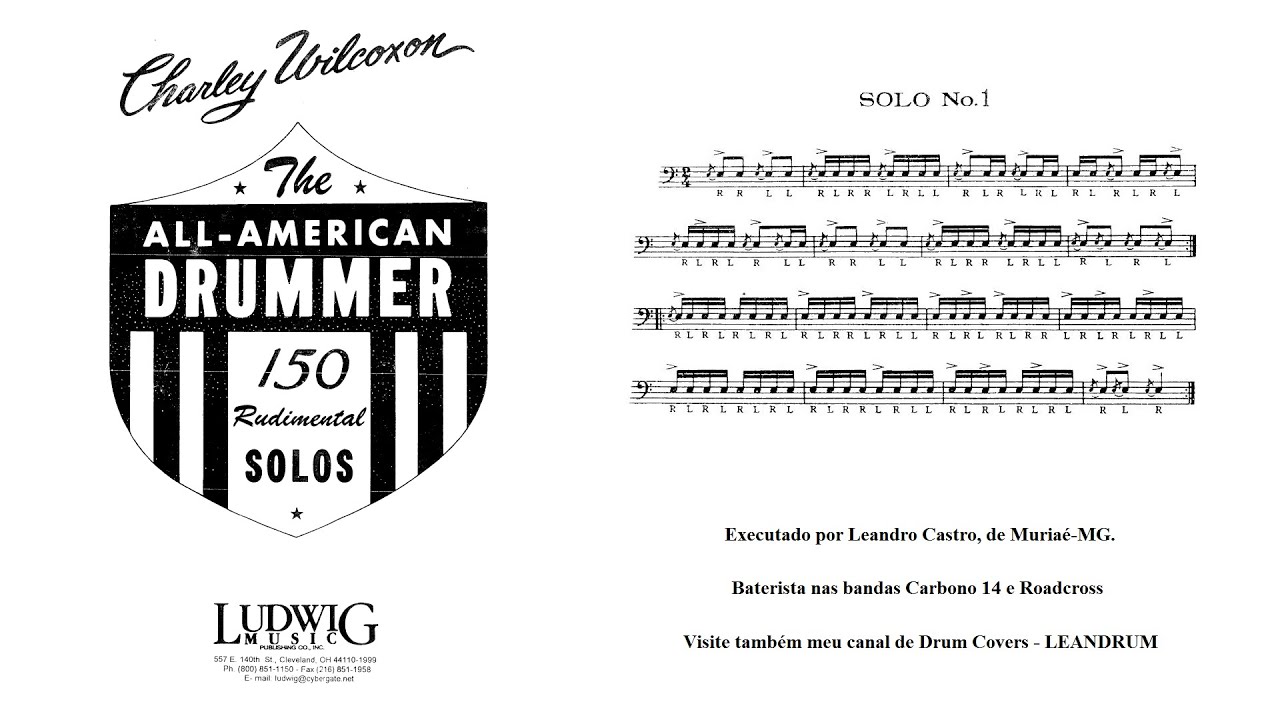
Rudimental drummers from around the world are posting videos of themselves playing one of the solos from the seminal collection "All-American Drummer: 150 Rudimental Solos" by Charley Wilcoxon.
This book is filled with intermediate to advanced rudimental solos that assume a knowledge of at least the first thirteen traditional drum rudiments (based on the 26 original rudiments as designated by the founders of NARD back in the 1930s -- NOT the 40 rudiments designated much later by Percussive Arts Society).
I wasn't challenged to join the group by another drummer, so I worked up a solo of my choice, joined the group and tossed my hat in the ring. It took several days to work up the solo to a reasonable temp, and another hour to play it through several times with the repeat without screwing up, before I felt ready to make a video of myself. Then it took another ten takes or so to get a clean take from start to finish. Even then, it was hairy going, and I could've done the end of the repeat better; but it was fun to challenge myself like this.
I'll totally do it again very soon.
(Here's my attempt for posterity, played in the new drum which still needs some gradual fine-tuning and tightening over the next week or so. NOTE: I chose to play the rolls timed and wide open, rather than to rush the drags and risk blowing the timing and tempo. It's an individual choice, and up to each drummer what to do with the rolls.)
Enjoy! And if you think you'd like to give this a try, contact Kevin Lehman at the Facebook group to learn more. The group has grown rapidly so that there are now a few repeats of solos but that's probably not a huge deal if most of the solos in the book are spoken for. Check with Kevin.
If you don't own this book, it's available at multiple book stores, including Powell's Books in Portland, and also from Reverb online.
Here's Solo No. 1 if you're so inclined to dive into the collection. I think it's worth owning a copy of the whole collection. Happy drumming!
During this week, my partner and I are both serving congregations as cantorial soloists.
But we're serving different communities and have to practice different music and/or settings.
In our very small house, that sometimes means we take turns practicing and the other goes somewhere else for an hour ot two to give each other some space and time alone in the house.
It was my turn the other day, so I took sticks and a pad over to the park and chopped out a little.
Since hanging out on the Marching Percussion Group on Facebook, I've learned quite a lot and have gotten exercises, advice and encouragement from some very experienced drummers, including a few rockstars who marched in drum corps in the 1960s and early 70s. Since my drumming in town is limited to to the community band I play with now and then, where the musical challenges are more ensemble based than rudimentally based, My rudimental chops are developing slowly after my eight-year hiatus in the late 90s-early 2000s; and I am slowly making up for some of the lost time.
My flams STILL suck, mostly because of my arthritic left hand; and I can play more easily only after soaking my hands in hot water in the mornings before I play. But my rolls and diddle exercises are smoother now, and I enjoy playing more than I did when I started back up again.
If time and logistics permitted, I would love to find a rudimentally-based drumline to chop out with, even if just for fun once a month.
When I was having health issues over this past winter, my counselor suggested I look at a meditative practice to help ease some of my symptoms and create a consistent way to begin my day.
I tried sitting still for five minutes, every morning.
That seemed doable. So I upped it to ten.
It got harder, but I hung in there.
I thought about upping it to fifteen, but my last day at ten minutes crashed and burned at around Minute Six. I was fidgeting and squirming and I couldn't sit still anymore.
So I gave up.
One morning after my failure, I was in the studio, fiddling with my sticks and a rubber practice pad (definitely a happy place). I pulled up my dog-eared copy of Stick Control and opened it to the first page.
I set up my metronome at something stupid slow like 70 beats per minute, and forced myself to play the entire first page as instructed: each exercise twenty times without break before moving onto the next one.
So the whole point of Stick Control is that it's meant to be sequential, methodical and very gradual. You don't jump from Page One to Page Ten. (You could, but you won't really benefit as much from just burning through and sight-reading. This is not a sight-reading book.)
By the time I'd gotten through the entire first page at that speed, I noticed two things:
a. My hands felt jerky and klunky at the beginning, and pretty smooth and comfortable by the end of the page.
b. Repeating every figure twenty times before moving on at 70 bpm took me something like 10 whole minutes.
I knew I was onto something.
Every morning after that, after eating breakfast and taking my meds, I went into the studio and played the first page of Stick Control, at gradually increasing tempi with the help of a metronome.
When I was done with that, I decided I wanted to play something else. So I pulled up book number two: 128 Rudimental Street Beats, a collection of drum cadence figures from the 1960s, by John S. Pratt (a master drummer of the time and the head drum instructor at West Point).
These beats are deceptively simple.
I figured that, if I could nail down the snare drum part, I could then get the bass drum and cymbals in my little community band to play steady time, with beats on the quarter-notes. (None of them are experienced drummers and a couple don't read music at all, so I have to introduce new material by ear and repetition.)
What I discovered along the way of selecting two or three street beats I could string together is that these things are actually a lot of fun to play. I memorized a couple and have incorporated them into my morning drumitation.
Finally, if there was time left in my half-hour time limit, I'd pull out
my favorite solo book of all: America's NARD Drum Solos, published in the
1940s and reprinted with fresh plates about 20 years ago.
The NARD Book was compiled by the first members of a new drumming organization formed in 1936, called the National Association of Rudimental Drummers. Their goal was to standardize the 26 basic rudiments (the "drummer's scales") known at the time and to encourage new drummers to adopt these standard rudiments as part of their training.
The original organization lasted until it disbanded in the late 1970s. A new version of NARD was established in 2008 and remains active today. This book, now in its third edition, remains a gold standard for rudimental drummers around the world, and it's the book I learned from in high school. (I still have my old copy!)
I don't always work out of this book every morning -- sometimes I get lost in Stick Control and allow myself to just zone out, because the point of drumitation is to chill out and calm down, not to work up new material all the time. But when I reach for it there's always something more for me to learn.
I learned a couple of these solos for contest in school. Because I couldn't afford private lessons I figured them out myself, and was scolded for taking this approach at contest. "You're a good drummer," the judge told me. "If you're serious about your drumming you'll make finding a private teacher a priority." (This was back in the good old days when it was unseemly to admit that your Dad was looking for work and you were eating tuna casserole for the fourth night that week. So I kept my mouth shut and nodded. Then I went home I continued to play and work out stuff myself. I did not have a private drum teacher on a regular basis until I got to college.)
In my return to rudimental drumming I find that I'm sometimes paying for my lack of private instruction early on. But since my primary goal is to enjoy myself and to use rudimental drumming as part of a meditative practice, I don't worry about that. I'm not currently looking for a private teacher (and I can't afford one, anyway). And sometimes I don't get to the drum pad when I'd planned to so I end up doing it a little later in the day. But drumming on a rubber pad has definitely helped me musically and emotionally, and for that reason I'm grateful I can still play.
I came of drumming age, as it were, in the days when marching drums came with Mylar heads, same as concert drums.
Around the time I had graduated high school, some drum lines were experimenting with a head made of woven Kevlar (the same stuff found in bulletproof vests). Kevlar was the new miracle material; drums heads made from it could be tuned higher and tighter than any Mylar head. As a result, kids in the 1980s began putting Kevlar heads on their regular drums, cranking down the lug bolts, and playing hard enough to break lugs and drum shells.
Of course, this led to the development of high-tension drums, with a free-floating shell and a tubular lug that could withstand the forces of cranked-down Kevlar heads. Eventually it even led to drum tuning wrenches that could handle the torque required to tune a high-tension drum. (I have one of these and I only use it on the aforementioned drums. It's complete overkill for anything else.)
The result changed marching percussion forever. Modern drum corps and marching bands now use Kevlar or Kevlar-Carbon hybrid heads almost exclusively. Today's kids are learning to play on these heads from middle school onward, with the result that it's ruining their concert technique (because we still use Mylar heads in orchestral playing and they require a very different touch) and it's ruining their hands and wrists in the long run (because the tension is so high there's no real "give" and all the shock goes into the hands and wrists, causing fatigue and a high potential for tendon and joint injury in younger players).
I had just missed the Kevlar boat when my marching days ended; The one season I marched in college band the school was broke and still had older drums with Mylar heads. When I began coaching high school drum lines, nearly every one was equipped with high-tension drums and Kevlar heads. I had to adjust my playing approach, and my hands became fatigued early on. Eventually, I learned to play examples on a pad and let the snare players figure out on their drums. (I didn't yet know that high-tension drums could cause long-term issues; I just figured it was because I wasn't used to it.)
When I joined the UBB last year, I scored a used Dynasty Wedge snare and carrier to march with. The drum's sound was tight and crisp -- and completely out of p[lace for the second-line style of playing I was being asked to do. But it weighed far less than a regular high-tension drum, so I hung with it until I came across this Ludwig marching snare drum from the 1970s, around the time I played in high school band. After some fussing and cleaning and little help from the fellas at Revival Drum Shop, The drum has become a serious player. And I love it so much I've put my Wedge drum up for sale.
You'll notice that, with Mylar heads, you really have to draw the sound out of the drum more; you can't just let the sticks bounce happily away, because Mylar heads will require you to do a little of the work, controlling the strokes with your hands and wrists. (This i why, back when I marched, we practiced at night on our pillows before going to sleep in the gym on tour. The pillow made us do ALL the work, and we built up our chops as a result. Today, I'm sure wouldn't be able to pull of half of what I'm doing with my arthritic hands, if I had not worked out this way as a kid.)
You'll also notice a fuller, deeper sound with a lot more space in it. That's because of both the shape of the drum and the lower tension required for Mylar heads, both of which lend more depth and color to the snare drum's sound. (My drum is a 14" x 10" model -- try this in a 15" or 16" snare drum from the 50's and you'll be amazed at the depth and darkness of the tone.)
Because you know what the other benefit of going back is? With a sling and leg rest, this drum weighs far less than my high-tension setup, and my whole body is happier.
Sometimes going retro is the right thing to do. I'll never play Kevlar heads again. Because I don't need to.
I wish I had more photographic evidence of my time spent devoted to drumming.
But all I have are these photos. Hopefully, they tell most of the story.
1. 1973: Why I chose drumming.
(Above: Karen and David Carpenter, 1969. Check that traditional grip.)
I'd already been playing beats on anything I could find. When I was seven, my best friend owned two Hoppity Hops (remember those?) and when we'd watch The Partridge Family at her house, I'd turn them into my drum kit while she grabbed a giant Magic Marker and made it a microphone. The year I turned nine we moved to California. My Dad bought me a cheap set of bongos at the souvenir booth at Frontier Village, a third-tier theme park in San Jose. I played along with records and the radio until the heads broke. Then my Mom patched them up with duct tape and I played them some more.
In the summer of 1973, we moved from Walnut Creek to Concord, California. In fifth grade I was old enough to take a music class at the new school. My parents, both trained singers, hoped I'd sign up for choir. Being terrified of singing solo in front of people, I chose instrumental music.
The teacher, a fine cellist in the local community orchestra, invited me to consider taking up the cello. I loved the sound, but it wouldn't fit in my bicycle basket and we only had one car. So I asked for something more portable. I was given the option of violin (nope), clarinet (definitely not) and drums, which at the time required me to own only a practice pad and sticks.
I was warned I'd be the only girl in the drum section, but that didn't bother me since I was already the only girl interested in lots of "boy" things (like skateboarding and BMX).
I suddenly remembered that Karen Carpenter played drums and she was awesome.
That last reason pretty much decided it for me.
2. Gresham High School, Homecoming parade, fall 1977.
I moved with my family to Gresham, Oregon in 1975. After living in or very close to much larger cities, I thought Portland (and by extension, Gresham to the east) was a hick town with provincial, almost tribal loyalties that made little room for new kids like me. Still, once we landed in Oregon we weren't moving again, so I made the best of it.
In my freshman year of high school, I joined the marching band and played a traditional single tenor drum. (I'm marching in front of the guy with the light blue saxophone strap, my face partly obscured by the saxophonist marching in front of me.) If it rained, we marched. If it blew hard from the east, we marched. A parent would bring hot baked potatoes to the drumline at every home football game so we could stuff them inside our sleeves to keep our hands warm. After we played at halftime, we'd eat them, still warm, while the infamous East Wind would come screaming out of the Columbia Gorge and almost rip my face off.
I loved those old-school uniforms; the white wool overlay could be removed to reveal a tuxedo jacket underneath which was worn for concert band. (Women wore blue vests and skirts and white blouses, all of which had to be sewn from an approved pattern. I sold my vest and skirt back to the school when I graduated.) And those spats! So cool.
Sadly, these uniforms were replaced the following year by ugly, "modern" zip-up jackets, black pants and new shakos that were glittery and over the top.
Today, my alma mater's band program has NO real uniforms. Concert attire is black pants or skirt and a white dress shirt; and the marching band plays in sweatshirts and jeans.
..::sigh::..
(Vintage content: We played Ludwig drums that dated from the 1960s. Today my tenor drum would be a collector's item, selling on eBay for upwards of $100 in good condition. In my senior year, I could choose to play snare drum, or the brand-new marching Roto-Toms that we ordered to approximate "corps-style" drum lines. I chose the Roto-Toms and had a blast. I recently acquired NOS tenor mallets with wooden heads, exactly like the ones I used in that final year, still in the packaging. I may actually play with them at some point.)
Later that summer, I marched for three months with the Spartans Drum & Bugle Corps of Vancouver, WA. Two months of rehearsals in the spring, followed by First Tour, a three-week barnstorming tour through the Pacific Northwest. Drum Corps was really hard on me physically, for reasons which would only become clear in adulthood; but I still loved it and was looking forward to going on the national Second Tour, which would culminate in a performance at the DCI World Championships.
It all ended when my mother met the bus at the corps hall on the last day of first tour, bundled me into our car, and on the way home told me I wouldn't be marching with the corps anymore. My father had lost his job -- a nightclub he'd been playing piano bar in for almost a year suddenly closed on him without warning. The next night they re-opened with a DJ; it was the height of the disco era and lots of clubs found it cheaper to hire a DJ than to pay a live band. When he complained to his union local, they told him he was on his own. My dad tore up his union card at that meeting and was immediately blacklisted.
I had to find work -- mowing lawns, babysitting, delivering the paper, or whatever else a fifteen-year-old could do for money. I spent some of my free time scavenging garbage bins and back alleys for pop and beer bottles; thanks to Oregon's landmark Bottle Bill, I could take the empties back for change, and that was my allowance each week. With the money from my part-time "regular" jobs, I helped my parents pay the utility bills all summer. (My sister was old enough to work as a waitress, and she was outgoing and really pretty so she got a lot of tips.)
We ate a lot of tuna casserole and my Dad didn't find steady work again for several months. I never marched in corps again, a regret that lingers today.
(Below: rumor has it I'm somewhere in this photo, though I barely remember the parade. We marched a LOT of parades during First Tour. I'll assume this was late in that tour, after I was switched from timps to bells, which would put me in front of the timps and out of photo range.)
3. Western Oregon State College, 1983.
I'm playing with our college stage band at the Oregon Collegiate Jazz
Festival, somewhere in Salem if memory serves. We weren't half bad. Our
kit drummer was a great player (though like most twenty-year-old guys
he was a little full of himself).
Our brass section was to die for. I
played Latin percussion and occasionally vibes. That is my old HS
concert blouse, the only dressy white shirt I owned at the time, with
black slacks and a vest I scored at Goodwill.
(Vintage content: Those congas are vintage Gon-Bops from the 60s. They were a thing of beauty and a joy to play. I really hope they're still being played somewhere.)
In the late 1980s I played with a band called Pure Imagination, a vocal quartet backed by a combo. We did charts made famous by the Four Freshman, the Modernaires, Lambert, Hendricks and Ross, and the Swingle Singers -- all the vocal jazz groups whose music I'd been weaned on in school. At the time I was also making money playing in pit orchestras for musicals and operettas (please don't ask me how I feel about Gilbert & Sullivan. Thank you.), and had a beautiful Ludwig four-piece Ringo Starr model kit with white marine pearl finish. I was so stoked to buy this kit that I held a "christening" party for it in my tiny apartment, and invited the cast and crew of the show I was playing in to celebrate with me. To my great surprise, a lot of them did.
Sadly, there are no pictures of me with that kit. In 1997, my right hand was seriously injured in a bicycle-car collision. After two surgeries and a year of PT, I was told that my playing would likely never be the same. So I sold most of my percussion instruments, including that kit.
This was the beginning of a ten-year break from playing drums and percussion, and the beginning of my career as a singer-songwriter.
4. Northwest Folklife Festival, Seattle, 2010, with Jack Falk.
Along with rudimental drumming, I'd learned to accompany singers -- my parents first, and then school jazz choirs -- on brushes. I loved playing brushes for singers because it taught me how to phrase and breathe with them. I maintain that singing, and working with singers, made me a better drummer.
In the early 2000's, I got married, bought a house, and longed to play drums again. So I started with just a snare drum and brushes, and practiced rudiments on a little Remo practice pad like the one from my childhood. Eventually, friends got wind of my return to drumming and invited me to sit in with them now and then. Jack Falk, a good friend of ours, had retired from his European touring to return to school and finish a Masters degree, and invited me to play out with him now and then.
Here, I'm playing for the amazing klezmer artist Jack Falk at Northwest Folklife, one of the largest and oldest folk festivals in the USA. I went up to Seattle in a Prius packed with luggage and other instruments -- I was also playing a solo set on the songwriter's stage -- so I could only bring a snare and hi-hat. Jack assured me that would be enough, and it was. In fact, he was so thrilled with how it came out that he asked me to stay onstage and play for a set by UW's student klezmer band, the Disciples of Goldenshteyn. It was a gloriously fat, messy set filled with laughing trombones and crying clarinets, and I had a helluva good time.
4. Kit drumming, 2010-12.
When I began to play again I assembled a drum kit from spare parts, obtained mostly at thrift shops, online and yard sales. The kit included a sweet vintage Royce snare drum that, for having only six lugs, sounded amazing. I converted a floor tom into a really small kick drum and rebuilt it with wooden hoops and bass drum heads. The idea was to use it to accompany soloists and small ensembles, so I never bothered to get a rack tom for it. By this time, though, didn't really have anywhere to play it, and because I was still working full-time as a bike mechanic I didn't have time to pursue it. I eventually sold the kit to a friend for twice what it had cost me to cobble it together.
5. Shalshelet Jewish Music Festival, 2013, Miami.
In all the time I'd stopped drumming with sticks, I was still making sounds on anything I could get my hands on, including doumbek, tar (African frame drum), maracas, and tambourines.
In 2013, one of my compositions was accepted for inclusion at a Jewish music festival taking place in Miami. At the same time, I was also forging ahead with a full-time Jewish music career, having left the bike shop for good in 2012. I played a fundraiser show to cover my airfare, and went down to Miami, where it was immediately clear that I was a Jewish singer-songwriter who could also drum. I made myself available to other festival artists and wound up spending a fair amount of time onstage at the gala concert.
I continued to tour as a Jewish artist and educator-in-residence, and added percussion to my educational kit, accompanying multiple artists and even ending up on a couple of their recordings.
Today, I am as often found behind a drum as I am singing out front at Jewish festivals and music conferences.
6. Tziona Achishena, Portland concert 2018.
Jack Falk called me last August. "The Sephardic shul [synagogue] is hosting an Israeli artist, she's awesome and needs a drummer. However, because it's an orthodox shul, no men are allowed at the concert [The orthodox have a rule about men not hearing womens' voices in public spaces]. You're the only woman drummer I know who could learn her tunes quickly enough. The concert's in two days and she says she'll pay a hundred and fifty bucks. Want the gig?"
I brought my percussive love to an audience of mostly orthodox Jewish women from around the Portland area, accompanying a talented and gracious artist named Tziona Achishena. It was a whirlwind evening, I hung on for dear life to the charts, Tziona was a brilliant singer and composer, the whole roomful of women and girls got up and danced through the aisles, and everyone had a joyous time. (Video, below: I'm accompanying Tziona on a five-gallon water bottle with an amazing sound.)
7. Today. Still at it.
I'm playing drums every morning, chopping out on a practice pad as part of my meditative practice and a way to help manage the depression I was diagnosed with five years ago.
Along the way, I've re-discovered the joy of rudimental drumming for its own sake, joined a community band and am slowly working my way to true drum happiness.
I make and sell little travel cajons from recycled wooden cigar boxes and repurposed snare hardware.
I've joined a couple of online forums dedicated to rudimental drumming and vintage drums, and I feel like I've reconnected with a piece of my childhood that was especially happy and today is a source of comfort and joy.