Showing posts with label Beetle percussion. Show all posts

Thursday, June 18, 2026

DIY Drummer: repairing and restoring a Beetle Last Pad

The Beetle Last Pad originally came as a doublesided pad with two playing surfaces and long tension bolts holding it all together. It was capable of very high tension and meant for modern marching drummers who wanted a pad with a Kevlar head on one side and a Mylar head on the other. 

Later, Beetle released a singlesided version of the Last Pad, meant for lower tension and a Mylar head. It was sold as a pad meant for old-school rudimental drummers, and if you installed a coated head it was also good for brushes. (I have such pad and to my surprise it has become my favorite brush pad, though I also like to chop rope drum style on it. The foam insert makes it feel very buttery.)

The seller bought a singlesided Last Pad and proceeded to assemble it with a Kevlar head and high tension — *not* what it was designed for. I’d guess he did this to save money, since the doublesided version costs far more. (The singlesided Last Pad currently retails for $180; the doublesided version costs $260. Both are worth the price when you take into account the sustainability and the amount of care and craft involved in their construction.

This singlesided Last Pad became available on eBay a couple months ago, and I watched it with interest.

Originally, the seller wanted $180 plus nearly $90 in shipping.

His description: “Beetle pad I bought not too long ago but don’t want anymore. Has some cracks from running but have changed the head with the cracks there, just don’t tune it too high. It has a Remo White Max Head.”

Sadly, in the process he cranked the tension so high — which is necessary for a Kevlar head — that he cracked the baseplate in the process.


I figured that the damage was rough, but repairable. I made a much lower offer, which was rebuffed. So I watched the listing and waited. So did at least fifteen other people.

I watched and waited for over a month, and the price fell over time. Finally, when the price fell to under a hundred bucks and the shipping became, frankly, more realistic, I felt ready to bite the bullet. I bought the pad and planned on repairing the baseplate with wood glue and clamps, and would see how it turned out. (I also planned to swap in an Emperor head and use lower tension.)

The pad arrived about a week later. The seller had simply tossed it in a box without any packing material. The cardboard box was ripped apart and crudely taped up again. The pad had bounced around inside the box and there was far more damage to baseplate than the listing photos had shown.

I gave the seller a mediocre review and told him to do better. Then I turned my attention to the pad.

I took it apart, and discovered that the previous owner had cranked down the tension so much that two of the bolts snapped when I tried to loosen them. Additionally, ten of the twelve washers were malformed from overtensioning. There were only single, large washers, not the second set of smaller washers that my singlesided Last Pad had come with.

I set aside the head, rim and bolts, and got to work on the baseplate.


Detensioning the hardware made the cracks narrower, so I had to slip a flathead screwdriver into the crack and widen it a little. I poured some wood glue into the crack, pressed it in with my finger and poured some more. Finally, I clamped the crack closed.

I repeated this with the crack in the second and third areas of damage, and set the baseplate aside to dry.


Then, I slipped the big washers into my bench vise and straightened them as best I could. That turned out fine and I felt comfortable reusing them at lower tension.


I chatted with Bradley at Beetle, who confirmed that this was probably a very early release of the singlesided Last Pad because it used only large washers. Subsequent versions have included two sets of washers and this works far better in terms of strength and durability.

I went through my parts bin and came up with replacement bolts and a set of smaller washers (old bicycle axle washers, nice and thick!) to add to the assembly.

Then, I waited for the glue to dry. Because I couldn’t be sure how far down into the cracks the glue could seep, I left the baseplate clamped all day. When I removed the clamps in the evening, the repair held solidly. Before stopping for the night, I drilled some vertical holes through the baseplate, two at each repair area, to receive hardwood dowels for greater stability.

The next day I got the fluted hardwood dowels to glue into the six stabilizer holes I’d drilled. The flutes carved into the dowel allow for glue to set in firmly with the wood and create a better bond and seal. When I ran this by Bradley, he suggested that the glue would do the job all by itself and that perhaps the dowels were overkill; but the bicycle mechanic in me really wanted to make sure the repaired baseplate wouldn’t come apart under stress. 

Valchromat (aka ForesCore), the material that is used in the baseplates and inserts of all Beetle pads that aren't built around solid wood, is made from compressed, finely ground wood fiber and a special glue. This is basically like MDF, but Valchromat uses very little formaldehyde and is much safer than ordinary MDF. Also, it's impregnated with color during the compression process so when you chip or scuff it, you don't lose color the way you would with wood that has simply been painted externally. It's also harder than MDF, and therefore a much better material all around. 

That said, if you're going to sand or drill Valchromat, it's still important to do so in a well-ventilated area and wear eye and mouth protection. Safety first!


In this photo, you can see where I’d had to build up the edges of the baseplate that had broken off. For this, I sanded everything, applied scotch tape around the missing part of the edge to form a “wall,” and poured in the glue to set overnight. When I removed the tape in the morning, a tiny bit of wet glue beneath seeped out, causing a slight collapse of the “wall.” Enough of the glue had dried that I didn’t worry about it. I knew that there would be enough of a repaired edge for my purposes, let the remainder of the glue dry and called it good.

The pad came with a 3/16” tire rubber insert, which would normally be too hard for my tastes. Bradley offered to make me a new insert with gum rubber so I could achieve something much closer to the feel of my 15” marching snare drum. While waiting for that, I decided to assemble the pad with the parts I have and see how I like it.

I let the glued dowels dry all day, and shortly before dinner time I assembled the pad with what I had on hand, including the harder insert and an old Emperor head. While I’m glad to experience the 3/16” recycled tire insert under a tuned head, it’s not really my thing and I will replace it with either a thin gum rubber insert or a 1/4” recycled tire insert, either of which will feel a little nicer for my hands. And I have a new Emperor suede head on order at Revival that should be here next week. 


Gosh, what a cool pad. I’m happy to have a second Last Pad for harder Mylar chopping, and thrilled to have repaired this at home.

(I was tempted for about twenty seconds to send the video to the seller, but my schadenfreude doesn’t run quite that deep. Mom raised me better than that.)

If you want a Last Pad, both versions are available on the Beetle Percussion web site, and are worth every penny.

Happy chopping.

Saturday, March 14, 2026

Product Review: Beetle Percussion Last Pad, Single-sided/concert

Early last year, I had an opportunity to put Beetle Percussion’s Last Pad through its paces. At the time, there was only a double-sided, marching focused version available. It was designed for modern marching drummers, able to take very high tension. You can read that review in two parts here, and here.

Eventually, after multiple experiments with that pad, I passed it along to a drummer with more experience playing modern, high-tension drums for further testing. Then, I turned my attention to other pads.

A few months back, I was offered the chance to try out the newer single-sided version of the Last Pad, designed for lower-tension concert and traditional marching practice. I readily agreed.

The single-sided Last Pad arrived this weekend, and I assembled it.

Beetle kindly sent the pad with two coated heads, one in single-ply Ambassador weight and the other in a heavier, two-ply Emperor weight. Since I already have a few pads with Ambassador heads on them for concert work, I chose to assemble this with the Emperor head.

The Last Pad comes with everything needed for assembly, including:

— Valchromat base, pre-drilled

— your choice of a lower-profile S-Hoop or a regular triple flange hoop

— all the necessary tuning bolts, nuts and washers

— a 14” insert consisting of 1/2” dense foam laid into a Valchromat base, designed to fit under the drumhead and on top of the primary pad base. You can order inserts made with recycled tire rubber if you wish, but the foam insert is necessary to make a lower-tension concert/traditional pad.

— a 14” head (not included in the base price, but you can buy one from Beetle for an extra charge or use one you already have)

You’ll need a standard drum key and a 5/16” open wrench. Beetle sells these as extras, too, if you don’t already have them.

The Valchromat primary base comes in multiple colors by request. My primary base is orange, and the insert (which is unseen once assembled) came in blue.

At left: the underside of the primary base, finished with foam discs for a nonskid experience on a tabletop.

Below: the top side of the primary base, inlaid with the same recycled tire rubber used on other Beetle pads.

The insert is inlaid with dense foam that, when placed under the drum head, provides a buttery feel that’s ideal for lower tings and coated heads.

Remembering my experience with the double-sided Last Pad and how the insert could wiggle slightly off-center, I put down a small rolled piece of clear tape between the primary base and the insert to keep it centered during tensioning. (Once it’s tensioned, the tape won’t affect the function of the assembled pad.)

The primary base comes pre-drilled to receive the tuning bolts, nuts and washers. I assume that two washers are used to provide greater strength and stability, with the larger washer going in first, followed by the smaller washer and then the nut. The holes of the washers have different inside diameters, so pay attention when assembling.


I took my time, using the overturned box as an assembly surface. Because everything came pre-drilled, assembly was very straightforward. However, you need to take your time and be patient because there are twelve nodes of contact. Tensioning and tuning properly will take longer, and you’ll want to make sure the insert doesn’t wiggle around while you put everything together. (The tape helps a lot with this.)

The holes are drilled to take counter-sunk washers on the bottom, and the elongated ovals make it easier to set up the tension bolts while you work your way around the pad. Once you assemble everything hand-tight, positioning each tuning bolt in or near the middle of the oval is straightforward.

After going around enough to ensure that nothing rattled anymore, I put the pad into a concert snare stand and began tuning more assertively. My concert stand of choice is a vintage Hamilton stand that is strong and heavy. The arms don’t line up with the cutouts in the primary base, but that’s not a problem here. A stand with three arms of equal length and distance will match up with the cutouts easily.

When it was all done, I tried it out. First, I used marching sticks:


Then, I turned to some concert sticks and tried some buzz rolls and a lighter touch:


Finally, I tried some brush strokes:


The foam insert definitely makes you put in a little more effort and thought to “pull” the strokes out of the head, just as you would when playing a traditionally-tensioned field drum or a snare from a drum kit.
That’s a feature of playing lower tensioned drums, and not a mistake. Anyone used to chopping on Kevlar will have to adjust their approach accordingly.

At some point, I may swap in the Ambassador head and try that out but honestly, I am so delighted with the feel and response of the Emperor head that I’m going to hang out with it awhile.

If you’ve been on the fence about the Last Pad, it’s worth the money and the time you’ll invest in it.
If you’re focused on marching snare and you chop on Kevlar, get the double-sided version and put different heads on each side. If you’re looking for a really fine concert or traditional pad, the single-sided is ideal. 

(Note: Beetle Percussion does not pay me to test and write about their pads, or to help market them. Now that they offer hoodies, though, I may just have to buy one.)

Happy drumming.

Monday, December 15, 2025

Want to make your own practice pad? PadParts.com can set you up.

I wanted to make my own Pad Parts pad, so I did.

Base: 11” green ForesColor.

Side A: 10” x 1/4” gum rubber.

Side B: 10” x 1/4” recycled tire rubber.

To apply the gum rubber, I lightly sanded the facing surfaces and used the Medium Weight super glue available at Pad Parts. Carefully spread, weighted down overnight and allowed to dry another two days in a well-ventilated shed before bringing it inside.

To apply the recycled rubber, I lightly sanded the ForesColor side, and dampened the recycled rubber facing side. Then I applied Gorilla Glue — a better choice for porous or textured surfaces — and followed the same weighting and drying steps.

For reasons I can’t define technically,  like the sound and feel of the recycled tire rubber more on the ForesColor (which I think is similar to Valchromat used on the bases of Beetle pads) than on solid wood. The smaller 11” size is easy to take along in a messenger bag or backpack and sits nicely on my lap, a tabletop or a snare stand.

And I saved money by putting together my own pad.

Color me a happy customer.

Want a nice pad? Do the labor yourself. PadParts.com will set you up with everything you need.


The recycled rubber comes in different thicknesses and is meant to provide a harder, faster surface for those who march high-tension snare drums.

On solid wood, as found in the craft-made pads from Beetle Percussion, the feel and sound are a little bit jarring, and harder on the hands because there’s very little shock absorption and the vibrations travel all the way up the sticks and into your hands.

On the ForesColor base, which I believe is related to the Valchromat base that is found on some Beetle pads, the sound and feel are a little more forgiving, allowing for a greater range of uses, styles and sticks. I like the way my Artifact Etude concert sticks feel on this pad, on both sides — something I wouldn’t enjoy as much on my Beetle Pine Pad with its solid wood base.

PadParts.com is the official side hustle from the same folks that make Beetle Percussion pads. The variety of base materials, playing surfaces, thicknesses and sizes allow for a wide range of possibilities so you can come up with a practice pad to suit your specific needs. PadParts also offers various industrial glues to provide optimal adhesion for your pad. If you have questions about how to work with these materials and glues, just reach out to PadParts.com and ask for instructions and suggestions. 

And remember, when using industrial glues, wear gloves and eye protection, work in a well-ventilated garage or outside, and allow to dry weighted down for twenty-four hours before bringing the finished pad into the house. 

Happy drumming!

Sunday, August 25, 2024

More adventures with Beetle Percussion: rescue pads

I’ve been making it a point lately to search for used Beetle pads and snap them up.

Why?

Beetle Percussion is a guy making practice pads, one at a time, in his garage. 

Each pad is craftmade from the most sustainable materials available, and sourced as close to home as possible. The result is a pad that is solid, sounds and feels great, and is beautiful to look at too.

Beetle Percussion goes into great detail about the dimensions and construction of each pad model, and you can learn more at their web site.

My most recent finds — I call them Rescue pads — are below.

1. Ash Pad. This was advertised by the previous owner as a Grass Pad, which is a different animal altogether. So when it arrived, I was really confused. I confirmed with Bradley Lomax at Beetle that this is, in fact, an Ash Pad. It’s just light enough to take along in a padded bag, and has two sides for playing. The wood is gorgeous. Looking at the edge, it reminds me a little of the poured sand sculptures I made at the shore when I was a kid, in tiny bottles that could be sealed up and taken home. 

Ash is a hardwood, which means that when used as a pad base it will provide a feel that is harder and faster, even though the response is still very pleasant to the hands. Sloppy beats have nowhere to hide on this pad. Also, hardwoods darken as they age, lending a beautiful patina to the base over time.


(The Grass Pad is made from hemp fiber, and the difference in appearance is striking. Check it out on the web site for more details. I may still try to find one of these for my collection later on.)

2. Pine Pad. This model was one of Beetle’s first, and remains a staple in their lineup. Using a much thicker (1.5”) base, it’s also a fairly heavy pad, and for that reason is not ideal for travel. (There was once a single-sided 8” model, which I have, but that size is no longer in production. The 8” version travels well and is fun to play.)

The two different thicknesses of recycled rubber offer different feels, though on a base this thick it might be harder to head a significant difference in tone. I have this one set up in a stand right now and have been getting to know it better.


I’ve already reviewed the Carlos Botello signature pad in a previous post, and continue to be surprised at how much I enjoy this model.

3. Tony Teleky Bus Pad. These were designed in collaboration with Tony Teleky, a drum corps alum and current instructor with Carolina Crown drum corps. He shares my passion for sustainability and is a terrific musician. He designed the Bus Pad precisely for the reason the name implies: chopping on a pad on the tour bus. The pad’s dimensions work beautifully in the confines of a bus seat, and allow for easy transport in a backpack.

(When I marched drum corps in the late 1970s, we traveled on school buses and chopped on a pillow on our lap, or on the tall padded back of the seat in front of us. Heavier, marching-specific practice pads did not yet exist. At home, most of us practiced on Remo tunable pads, or a rubber pad like the Ludwig “keystone” model. Kids with money might find a Trankle Pocket Pad, though they were spendy for the time at over $20 each. Many of us made our own pads from a phone book and duct tape, which was good enough in the days of lower-tension Mylar-headed drums. It was, as we say, a different time.)

There are two generations of this pad in existence: the first was a single-sided pad with a solid wood base and 3/16” recycled rubber surface. It was very popular when it came out. The Bus Pad was later revised and the second generation is now made with a Valchromat base and two playing sides: one is made of naked recycled rubber, and the other is recycled rubber with the same laminate as used on the Botello pad. I obtained mine in a straight across trade for another pad. There are a few very tiny dents in the laminate, but only one is really noticeable, and it’s not enough for me to ask for a replacement laminate.

I have been enjoying this little pad a LOT. The playing surface on both sides is very nearly perfect, and positively dreamy for portable chopping on the bus or at the park. The perfect size for travel — this one fits in my bicycle saddlebag!

I may seek out an older version of this pad for sake of including it in my collection, but it’s not a high priority. If one falls into my lap, great. If not, that’s okay too.


4. In addition to these Beetle pads, I also have an original BAP (short for “Big Ass Pad”), made of solid pine and recycled rubber and measuring two feet in diameter. I bought this on sale when the last of them were being offered on closeout. The plan was to discontinue this version because the size wasn’t popular enough for the costs involved in making and shipping it and still remaining competitive.

I’m ashamed to admit that right now, my BAP functions as a bit of a catch-all table in my studio. I hope to rectify that situation soon. 

For quite awhile, there was no word as to whether the BAP’s demise was permanent, or just a long term hiatus.

That question was answered earlier this year when Beetle announced the release of a new version of the BAP, this time made with a Valchromat base and including a smart carrying handle.

If I were holding a monthly pad party in my community (something I’ve dreamed of doing, tried twice and gave up — maybe I’ll try again this fall), I might find the new version of this pad to be a nice thing to add to my stable. If you work with a drumline or afterschool arts program, you might investigate this pad as a useful resource.

I’ve now given myself some impetus to clean up the space a little and use this baby more.


There are so many — probably too many — mass-produced practice pads on the market today, and in my humble opinion, most are overpriced for how they’re made and what you get. (It’s telling that Remo’s tunable pad, first released in the early 60s and still made today in 6”, 8” and 10” sizes, still finds its way into the hands of schoolchildren across the country and around the world — and at a price far more commensurate with its construction cost and long term value. The 8” size, now considered the standard size for student use, retails for around thirty-five bucks. Compare that to the price of a gray Evans pad, with the same retail price of $35, but which is not as durable as the Remo and cannot be refurbished when it wears out.)

All those mass-produced pads have an environmental cost that isn’t taken seriously enough today.
That’s why I try to stick with pads with a higher sustainability quotient, like tunable pads whose heads can be replaced (pro tip: cut up the old head for those little strips to attach the snares to a drum), or pads made more sustainably (like Beetle and, to a lesser extent, Mad Pads, both of which source their components as close to home and/or recycled as possible and use local labor to make them).  

I encourage you to ask better questions about the drum equipment you buy and use, and seek out products that offer as high a degree of sustainability as possible, including buying local and/or used, trading for other gear, and choosing products that are lower on the environmental supply chain where possible.

I’ll share more sustainable drum goodness as I find it.

Wednesday, August 21, 2024

I take back ALMOST everything I’ve felt or said about laminates: Beetle’s Botello signature Pad

If you’re a regular reader here, you know that I’ve never been a huge fan of laminates on practice pads.

Growing up on Mylar, I just never felt the need for adding something  that resembled Formica to what was already a perfectly decent pad.

So over the years, I’ve tried lots of laminated practice pads, and I have found most of them ranging anywhere from pointless to horrible.

I originally tried this pad three years ago, and because at the time I was doing a lot of drumming on older vintage drums with Mylar heads and standard tuning, I didn’t really appreciate the pad at the time.

More recently, I had an opportunity to buy this pad used and decided the price was worth the risk. Maybe my hands and head were in a different place now.

The Carlos Botello signature pad from Beetle Percussion is designed in partnership with percussion instructor, arranger and performer Carlos Botello, who teaches drumlines across the country including the Crossmen Drum & Bugle Corps. He’s also the creator of the multi-volume instructional series of books, The Left Hand Path (which are available online).

Carlos Botello and Bradley Lomax designed a really nice practice pad. You can click on the link that will take you to the Beetle page for this pad and read about the details that go into making it.

Disclaimer: I bought this pad used in a private party sale. The construction is identical between my used pad and the pad currently sold at Beetle’s web site. My pad is an early iteration of this model and lacks the graphics on the top laminate, but otherwise it’s the same pad.

My pad has been through the wars a bit — dropped, scuffed, played a fair amount (though happily, my laminate has no dents in it) — but works as advertised.

The top of the pad has a 1/4” thick recycled rubber surface, covered by a Mylar laminate. One might think that this is just another hard, unforgiving Formica-like playing surface, but they’d be wrong. 

This side plays like buttah.

It’s soft enough that the laminate offers useful articulation instead of undue resistance. The Valchromat base is more durable than MDF and if you drop it, there’s no surface paint to scrape off because the fibers of the Valchromat are impregnated with the plant-based color all the way through.

The rubber rim is soft, but embedded deeply into the base so it will stay put, and gives just enough presence for you to know if your rim shots are accurate or not.


The bottom surface includes Carlos’ signature and a 1/2” thick layer of dense, soft foam. This side is meant to give you a place to build your wrists and get a good workout. There is almost no rebound at all, which makes it similar in intent to the pillows we used to practice on while on drum corps tour, and when you play on normally-tensioned Mylar heads, such workouts make sense.

If I were still possessed of younger, stronger hands and not bothered by advancing osteoarthritis, I might find this surface useful in my practice. But working on such a surface now would actually be quite painful and potentially harmful for my hands and wrists, so I will likely just avoid this side completely. 

(NOTE: I’ve reached out to Beetle Percussion and asked about the possibility of swapping in a non-laminated recycled rubber surface to replace the foam. If they can cut a Floppy Disc to match the shape on the underside of the Botello pad, swapping the two shouldn’t pose a problem, and I can do the swap myself.)

I think the combination of the recycled tire rubber and a real Mylar laminate (similar to what’s used to make a drum head, though perhaps a little thicker) makes for an ideal practice surface, especially for Rudimental and marching applications. It’s articulate without being harsh in feel or sound, and the surface will indicate your accuracy immediately without hesitation.

Having tried other Beetle pads with a rubber rim, I can say that the rim is a little soft for my liking, and I wonder how long it will remain durable enough to help me gauge my rimshots. Because this pad is so used, I may stiffen the rim a little by adhering a very long zip tie to the outside wall of the rim. I’m waiting to hear back from Bradley at Beetle for his thoughts first.

The pads are currently available at the Beetle web site, but be warned: high-craft pads like this are made one at a time and you could be waiting a month or more for yours to arrive. Also, pad models are made on a rotating cycle (because the cutting machinery must be reset for each pad’s thickness and diameter.

Various models of Beetle pads go in and out of stock depending on the model schedule, so if a model is out of stock, contact Beetle and ask when it might be available again.

Beetle is my absolute favorite American practice pad maker today, because they pay attention to their impact on the environment and do all they can to reduce negative effects by incorporating as many sustainable manufacturing practices as possible. This does make their craft-made pads more expensive than mass-produced rubber-on-wood pads, but in my humble opinion it’s worth the extra cost.

This Carlos Botello model could became my new favorite rubber drum pad for awhile.

Tuesday, February 1, 2022

Interview with Bradley Lomax, Beetle Percussion

Bradley Lomax got his start in drumming as a child. Participating in school music programs and drum corps, majoring in music in college and growing a massive set of drumming chops, like many who read this blog. Along the way, he became aware of the impact that our lives have on the environment, and how the environment has responded to our impact; and at that point he became a champion of sustainability in all things. Because of that commitment he makes each Beetle Percussion product himself, using as many recycled or repurposed components as he possibly can, and his practice pads are some of the most beautiful in the world.

This makes him something of a rarity in the drum industry, and someone I’ve been dying to chat with for almost a year.

Here’s our interview.

BH: How did you go from playing to making drum equipment?

BL: I got really serious about drumming in high school, and after high school I marched a few seasons of drum corps (first with the Sky Ruders and then with Pioneer). My sophomore year in high school, I got a job working for Bill Cardwell at C&C Drum Shop, where I taught private lessons and in my spare time I watched and learned about the craft of drum making.

I got so into making stuff — learning at C&C and also taking jobs in construction — that eventually I left college and went into teaching lessons and doing construction pretty much full-time.

BH: What was your inspiration for starting Beetle Percussion?

BL: When I was growing up, my parents would take me on vacations in Colorado, and I loved it. Everything was so green and beautiful and I loved going back again and again. After I left school, my parents went back to our favorite vacation place and returned to tell me that beetles were destroying the trees there, eating them to death.

Global warming was forcing the Beetles to turn to these trees for a primary food source in increasingly huge numbers, and whole forests were being destroyed. The whole area was transitioning into some kind of arid desert because the trees were dying. I was horrified.

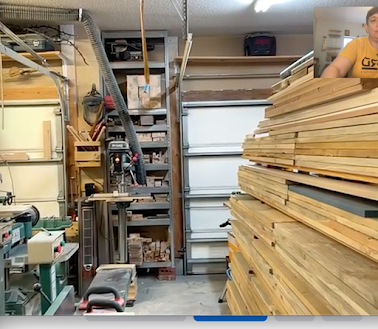
Since I work with wood, I decided to create something that would use the wood from these trees  and I hit upon the idea of practice pads. I called the US Forest Service to ask about getting some of that wood, because they had to clear it out of there before it became fuel for a forest fire; and they referred me to a bunch of mills who were taking the reclaimed timber and turning it into furniture and stuff.

I established a relationship with one of those mills, who brings me some of the reclaimed lumber; they deliver it on pallets right at my workshop.

At first, I tried making pads out of natural rounds, with the bark and everything, because I thought they’d look cool. But working with wood that way is really, really difficult and trying to force it into shape just wasn’t working. So ultimately, I had to set up a serious wood shop with all sorts of planing saws and things, learning how to treat the rough wood like potential furniture. After that, my vision for the pads became easier to clarify. Basically, I make practice pads like furniture, and that’s why they look so finished and smooth. There really isn’t any other way to make them turn out so good.


We source recycled car tire rubber from a company that supplies  it to flooring manufacturers. Because it used to be car tires, we sometimes have to pull out bits of metal — old nails, sidewall material, and stuff — so that we can work with just the rubber and mold it into a playing surface.

BH: What’s your target market? I assume it’s more connected to the marching arts, because your pads are fairly hard. I don’t currently own a Beetle pad but I’ve tried a few and that’s my takeaway.

BL: Yes, the overwhelming majority of people who buy our pads are marching band and corps members who want a pad that feels more like a marching drum head. I’d say almost 90 per cent of our customers fall into this category.

What’s great is that college instructor are excited by the “green” aspect of our pads, and they hype that to the kids and get them thinking about it, and suddenly it’s cool to play a “green” pad.

As to why the pads feel harder, a lot of that is the wood that’s used. Ash is a very dense, hard wood and that makes it great for building a marching pad around; pine, on the other hand, is a softer wood and will give you a response that’s a little closer to a concert or all-around pad.

BH: What about different thicknesses of rubber? Would that affect the response?

BL: It would, but only to a point. Thicker than a quarter-inch and it gets kind of dead-feeling. That’s why we stick with 3/16” and quarter-inch thicknesses on our pads — they just give the best response and feel.
And honestly, we have to respond to what our customers tell us they want. Since they’re mostly marching drummers, we have to give them a pad that responds the way a Kevlar-headed drum would.

BH: Fair enough.
In addition to your commitment to using reclaimed timber and recycled rubber, how else do you promote sustainability at Beetle?

BL: For every item sold, a tree seedling is planted to replace the tree that was destroyed by the beetles. We partner with forest management agencies in Colorado to accomplish this. Removing harmful material and planting new trees helps to stabilize the watershed, restores wildlife habitat and promotes regrowth.

BH: Now, for the hard questions: You make your pads as sustainability as possible. But the carbon footprint involved in that process, from gathering raw materials to shipping out finished pads, cannot be denied. How do you weigh this reality against your efforts? And how wide-angle can you go in your vision before it drives you crazy?

BL: (laughs) Yeah, it’s true. I plant trees, I use reclaimed and recycled materials, and I know it only goes so far. The truth is that none of us can control everything. We can only control what each of us can control, right where we are. It’s a double-edged sword and I do what I can. When my HOA lets me put solar panels on my roof, when everything can be delivered without relying on fossil fuels, that will be wonderful. In the meantime, just getting the kids to be more aware of the need for a more sustainable way of life is a win. We plant seeds and they carry them forward.

I can only do the best that I can do. And hope that enough people will notice and start to pay attention to the places in their own lives that can be made and done more sustainably.

BH: Well, you get no argument from me. I LOVE that there’s a company promoting sustainability and I look forward to more people taking notice and paying attention.