Wednesday, October 1, 2025

Inflation has led to deflation: Used practice pads

I've researched and collected historic drum practice pads for a long time.
When I began my deep dive, almost no one else I knew was focused on historic drum pads, so that made it easy for me to find old pads at bargain prices. 
But by 2018 or 2019, things had begun to change, as more drum enthusiasts found vintage drums increasingly unaffordable and/or unattainable. Many of them turned their attention to other drum-related collectibles, including practice pads.

Before the Covid pandemic closed down the world, a brisk trade in vintage practice pads was on the rise. Alongside that, some of the big drum manufacturers were investing heavily in marching- specific designs and throwing a lot of marketing at younger drummers who were just coming into their own in the marching arts. 

During the pandemic, the practice pad market grew exponentially, and quickly. Those with an eye towards profit were punching above their weight with new models of marching-focused pads almost every season, while older drummers who had marched in the 1990s were now selling off their own vintage pads to turn a quick buck. 

If you've followed this story, you know that tan RealFeel pads made before D'Addario acquired HQ began fetching prices in the triple digits, Xymox was running the table for a little while and half a dozen other companies were trying to catch up. It was exciting for maybe a decade at most, and then the wheels gradually began to fall off. Xymox had horrible supply issues and atrocious customer service; Drumslinger learned that a one-man shop could never keep up with the likes of Vic Firth and Evans; and Prologix basically sold its soul. Whenever I pointed out the excesses of the practice pad industry, I would get shouted down by guys who worked for those comp[anies or who had helped design some of their most-hyped models.  

The shop bosses don't like canaries in their coal mines. They serve a useful function for the minders, but they also eat away at profits by slowing down production.

Now, in late 2025, the bottom has begun to fall out of the used practice pad market as so many enthusiasts who bought up piles of cool pads woke up and realized that (a) they weren't marching anymore, (b) they had bills to pay and (c) the pads they'd paid an arm and a leg for were now worth less than a quarter of their original value. 

Suddenly, the market was glutted with more pads than drummers and prices fell like 1920s wheat prices. (Millennials, look it up.)

Today, you can find an old tan RealFeel pad for under $100 and sometimes for less than $50 on Facebook Marketplace. HUN's M-12 pad (which was rebranded for RCP as their Active Snare pad) is now selling used for less than $25 used. Evans gray pads, which were never my favorite but which are ubiquitous, are selling for as little as $5.

The only pads which seem to have retained some value are those whose supply was controlled their makers: Evans red Barney Beats pads still fetch a high price due to artificial scarcity caused by Evans decision to make it a limited run. Beetle pads are made in small batches, one at a time, using sustainable practices that would never work for a large-scale manufacturer and those pads still demand competitive prices even in used condition.

While the practice pad market was beginning to capsize, I had turned my attention to making my own pads from scrap and repurposed materials. I was also recovering from two years of Long Covid, and didn't have the money or the energy to keep collecting in the same manner as before. My priorities began to shift. I focused on a handful of older, vintage pads that continued to have lower demand among the younger pad crowd, and for which there was a lot of documentation I could research. But my pad acquisitions really began to fall in 2024.

More recently, I decided to downsize my holdings in general after being approved for Disability. Knowing that I would not get a great return on my investment, especially for the marching-focused pads I still owned, I began to sell these, mostly at a discount. (In some cases I donated them to students so the pads could still see use. I am very happy that somewhere, there are schoolkids practicing on one of my pads.)

My collection at its peak numbered close to 200 pads of all kinds. That was in early 2023. Since making the conscious choice to pare down, I'm now at around fifty pads. I have plans to sell a few more of these and get down to the pads I enjoy chopping on the most, plus a couple of really rare, old pads that I find beautiful and historically interesting.

I had a lot of fun researching and find historic pads. But as I've begun to come out of serious illness and am adjusting to life in retirement, my priorities have shifted. By making more space in my material life I'm being open to whatever comes next. 

So if you're looking for a good drum practice pad, this is a very good time to shop online and at yard sales. I'll post some of my pads soon at the Drum Pad History Group on Facebook, and donate whatever I can't sell to a school. 

I haven't give up on drumming! I still chop a little every day and get a great deal of pleasure from doing so. I'm just getting more focused about what I chop on and why.

Happy drumming.

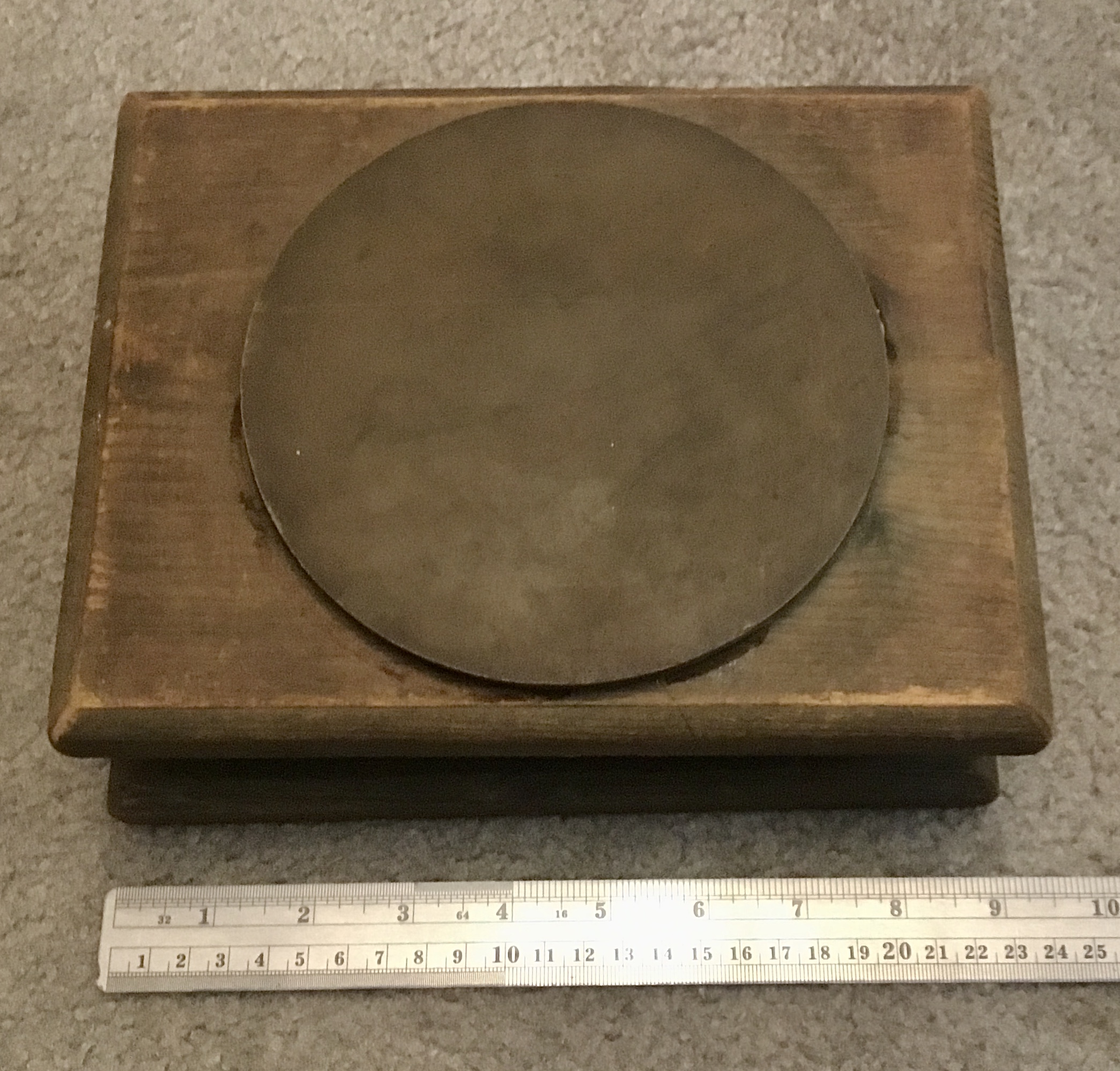
(Photo: George Stone practice pad, 1920. Back when a practice pad was just a horizontal surface that kept the neighbors off your back, and nothing more.)


Monday, September 8, 2025

The beginning of the end of big-name practice pads? I’m sort of ready for that.

I am winding down my practice pad collection, probably for good.

I’ve been pondering this step for a long time. I’ve made a few halfhearted tries in the last few years. But something has changed, in me and in the world around me, and I find myself in a new place that I am finally beginning to recognize.

The fact is that I’m preparing to enter a new phase of my life, one which likely does not involve teaching or drumming professionally and one which may not even involve much drumming in public for the foreseeable future.

Since the pandemic and its related events turned my life upside-down, I’ve been floundering. Getting far enough past Long Covid simply to function like a person again took over two years, and residual issues have lingered long enough to force me into medical retirement.

I’ve struggled to find my bearings since I began to improve; not knowing where or how to be useful, not able to promise a regular schedule or a regular level of energy while I’ve dealt with various medical issues, and feeling really lost.

Last week, a local All-Age drum corps invited me to join them in the pit playing mallet percussion. Playing in a drum corps pit would require me to manage not just playing mallet instruments, but also moving them and loading them on and off trucks at performances. Add in the fact that the corps is based in Milwaukie, and I’m transit-dependent, and it would be an unworkable situation that I could not guarantee a meaningful commitment to. There was a time I might have leapt at the chance, but that time has passed. I thanked them for the invitation and politely declined.

While I am getting stronger and more functional, there are definitely limits to my functionality and my energy level that signal it’s time for me to consider other possibilities. I can still play rudimentally, but marching and performing are just not happening at this time. And without the incentive of rehearsing I admit my interest in drumming has flagged a little.

Which brings me to my other line of thinking, especially about practice pads and my interest in them.

I have a feeling that the practice pad tidal wave is beginning to fall. Too many similar designs of higher-end pads have flooded the market since the beginning of the pandemic, and not enough people or communities have rebounded financially since Covid began to recede. Add to that the struggle of so many school groups just to stay afloat, let alone field a marching band. Even if Drumpf and Co. DO get shown the door, there’s too much damage done to repair anything in a lot of what’s left in my lifetime. It’s sad. I try not to dwell on it too much.

So I am beginning to sell off as many of my pads as I can. I hope to reduce the number down to perhaps a dozen or so pads that I use and enjoy regularly. I’ll offer them at decent prices, and whatever I can’t sell I might donate to a youth group.

I’d hang onto them, but I’ve encountered a lot of apathy in my attempts to spark interest in Rudimental drumming locally. Portland just leans way too far to the hard left on so many issues, for there to be much purchase beyond well-funded suburban schools.

At the end of the day, it’s just a practice pad. And maybe someday it will be just that, and no more, again. More and more, I think that would probably be a good thing.


Saturday, July 12, 2025

The ages of Sabian Quiet Tone pads, revisited

The original Quiet Tone pads were made in New Jersey and were popular among concert and jazz drummers and studio teachers. Those original Quiet Tone pads are very hard to find, and insanely hard to find in still-playable condition. 

In the 1990s, Sabian bought the rights to make and sell the design and moved manufacturing to their Canadian cymbal plant. These Canadian-made Quiet Tone pads retained the white rubber feet and a very similar base compound to the originals. They were quite nice, a little sturdier than the originals with a great feel.

In the later 2010s, Sabian outsourced the manufacture of the Quiet Tone pads to Taiwan and eventually to China. Adding black mesh models to the line required Sabian to designate the white-headed, solid pads as “Classic.” The Asian-made Quiet Tone pads are, in a word, junk. The base compound was changed to save costs and the fat white rubber feet became smaller black rubber feet.

Generally, speaking, there are two ways to discern between the early and current Sabian Quiet Tone pads.

First, look at the label on the underside. 

The earlier versions of this pad will indicate a Canadian address and a model number ending in either TT (for “Tom Tom,”) or SD (for “snare drum”). The older “TT” pads were available in sizes t 12”, 13” and 16”. The “SD” pads came in 10” and 14” sizes. I believe this wider size range had once been available before the pad design was bought by Sabian; it’s highly possible that Sabian simply changed the labels and continued to sell off those older sizes until they were gone, but I can’t be certain.

The newest Asian-made Sabian Quiet Tone pads have added the letters “CL” (for “classic”) to the end of the model number, and only the 10” and 14” size are available.

The other distinct feature is that, on the earlier Sabian pads, the Quite Tone logo was designed with the words, “by Sabian” added to the right and outside of the logo. The Asian-made pads incorporated an even smaller Sabian logo just below the Quiet Tone logo. And of course, older pads should have larger, white rubber feet.

Below: a full set of early Sabian Quiet Tone pads in the full size range, and the bottom of a 12” pad showing the old label and white rubber feet.


A newer Sabian pad with the newer logo and black rubber feet. Also note the difference in the shape and width of the metal struts. They’re slightly thinner on the newer pads and may be more prone to bending out of shape if dropped or knocked about.


To find the earlier Sabian Quiet Tone pads you’ll likely have to look for used models online. The new, Asian-made pads are available in music stores and are, in my opinion, overpriced for what they’ve devolved into.

If you end up with a newer Sabian Quiet Tone, you can experiment with adding a thin layer of mousepad material under the head to see if it improves the feel and tone at all. I can’t guarantee the results.

Here’s my early Sabian Quiet Tone in the 10” size. It feels and sounds lovely, especially with concert sticks.


I continue to search for the earlier Sabian Quiet Tone pads in other sizes, especially in 12”.
Happy drumming!

Friday, June 13, 2025

Repairing vintage Ludwig pads

I love these old Ludwig pads from the 1960s and 70s.

For anyone who grew up playing on Mylar heads, these are darned near perfect. The feel is the closest to a real drum without the volume. They were sold separately and were also included in student kits with snare drum and bells.

Finding one today is difficult. Model P-378 (8”) turns up more often than model P-379 (10”), but you really have to scour the online want ads for them. Ludwig stopped making these pads in 1980 or so. They offered the parts for a few more years, but then stopped making those too. Very occasionally, I’ve found a replacement head or a few tensioning nuts online, but they’re rare and expensive because the seller usually knows what they have.

When I do find one, they are very often quite used, sometimes abused, and in need of repair. Lacking a supply of replacement parts, I’ve had to make do with what’s in front of me.

The original wood used for the baseplate and internal base was very soft, probably pine, to cut down on production costs. Unfortunately, that means it’s fragile and wears with time and use. The construction is simple, and that means a worn pad can be repaired or at least extended pretty easily.

So far, I’ve been lucky. I’ve been able to repair every pad I’ve found and make it useable again. Sometimes, it’s a matter of removing pieces, cleaning them up and reassembling.

Other times, the wood baseplate is pretty beaten up — splintered and/or warped — and I have to remove all of the metal buts, reverse the baseplate and reinstall them from the other side. Doing this helps to reverse some of the effects of warping, and gives the heads of each “finned screw” new wood to bite into.

In a couple of cases, owing to lack of replacement heads, I’ve chosen to add another layer to the head. Either from the underside or directly on top, to help the head last longer. Neither approach seems to affect the sound or feel adversely.

The latest pad I found, an 8” model, came from a private seller cleaning out her garage. We agreed on a price and I got the pad home, where I dismantled it and examined the pieces.


The baseplate was pretty hammered, and one of the tensioning nuts had rusted frozen to the finned screw. In order to save this pad, I would have to carve a bit of the wood away so I could gain purchase with pliers
and hold onto it while applying a spot of oil and turning the tensioning nut. I reasoned that when I had removed the screw, I could fill in the gouge with a thing piece of wood cut to fit, apply it with wood glue, and gently poke a new hole in the spot.

After removing the final screw, I filled in the divot with the tiny piece of wood and set it in the divot with wood glue, clamping it in place. When it dries, I should be able to carefully drill a new hole, ream it to size, and reassemble the pad.


(The tape applied on the side is there to keep the wood glue from running out.)

Once dry enough, I removed the clamp, poked a hole and called it good. The screw went in easily, and held fast to the new underside.

Other enthusiasts of this make and model, most notably Rick Dior, has a full workshop of tools, so when he has to restore one of these pads, he simply cuts a new baseplate from hardwood and installs the metal pieces into the new baseplate.

Since I don’t have power tools or much woodworking experience, I tend to do repairs that are more rough-and-ready. My goal is to make these pads useable again, not museum-worthy.

After flipping the baseplate, I reinstalled the threaded hole assembly. This required some care, so I wouldn’t crack the plywood baseplate while sinking the teeth into the other side. I laid shop rags across my bench vise with the jaws open, to allow the threaded center to poke through the other side without mangling the metal. 

Then I reinstalled the thick seating washer and the little rubber feet. I also laid in some Elmer’s Glue-All along the edges where the plywood was roughly finished. The hope is the fast-drying glue will help to keep those edges from splintering further. I can color them in with black paint pen if I like. 


And voila! Good enough to play for years to come.


Meanwhile, I’ll keep my eyes peeled for replacement parts.

BONUS TIPS:

1. In the old Ludwig parts catalog from 1970 (see first photo at top), The square nut for the tuning assembly is referred to as part # P-124. If you try to look for this part today you won't find it, as Ludwig stopped making it years ago.
However, Ludwig continued making and selling their part # P-125, advertised as the
2. Thanks to fellow Ludwig pad enthusiast Rick Dior, I was able to obtain these black vinyl end caps that slide over the tuning nuts, thereby saving my sticks from getting chopped up during practice. 
You can find them on eBay and elsewhere, or perhaps at a large local hardware store. For this application, get the size with the 6.5mm inside diameter.


Sunday, June 8, 2025

Dating vintage practice pads

Some key points for those looking at old pads:

— Brown gum rubber may have been lighter tan. The only way to verify this is to peel back an edge and peek. Gum rubber that hasn’t been exposed to sunlight will retain more of a tan color. (If you accidentally pull off the gum rubber too far, simply glue it back. Spread a thin coat and roll a drum stick across the top to spread it evenly, turn over and weight down until dry.) 

— Mass produced, or homemade? How to tell? While it’s not an exact science, it’s worth noting that in the mid 20th century, a lot of Americans still knew how to work with simple hand tools and many did their home minor home repairs. The wood finishing here is just rough enough for this to possibly be homemade.

On the other hand, lower-grade wood was reserved by drum companies for things like practice pads, and the nicer quality planks 

That said, the small matching “feet” on bottom, and the clean cut of the round rubber and the edged wood top and bottom panels, both suggest that this may have been made in a local factory for a music store to sell. I’d guess a smaller, local outfit made it because of the lower overall standard of the wood used. (Most homemade pads wouldn’t be edged, and I’ve yet to see one with matching feet.)

— The larger 9 x 7” sized pads became less common in the late 1950s, as bigger drum companies sought to streamline pad manufacturing by offering fewer models. A smaller, standardized size would reduce the material required and cut costs. 

A pad that has no label or stamp can be harder to place, but I’d feel comfortable estimating this to be a smaller-scale, mass-produced pad from the late 1940s to early 50s. Happily, the rubber still feels great to chop on.


Saturday, May 31, 2025

Vintage Corner: 1950s pad from Kitchen & Company, Leeds, UK.

This was a lucky find on eBay. I knew nothing about the design or the original company, but it was so unusual that I knew I wanted to add it to my collection. I contacted the seller and asked if she’d be willing to ship to the US, and she was delighted to calculate the cost.

It arrived today.


Based on how hard the rubber playing surface is, even accounting for its age, I think the pad might have been meant for pipe drummers. I have another pad of similar vintage (made in the US) using similar rubber and it’s only slightly softer than this. The pad itself measures 12 inches across. The arms extend out beyond the diameter of the wood base, but the placement of the softer gum rubber feet attached underneath suggest the pad could be used sitting atop a standard 14” snare drum. Despite its age, the gum rubber feet are still quite soft. I haven’t yet tried this on top of a snare drum, but that’s coming.

The age of the pad is unclear, but some clues suggest at least a rough decade of the 1950s:

— the wood is beautifully finished and stained like good furniture.

— the feet are the pure gum rubber found only on pads from the early 1950s or earlier.

— the badge is made of a thin white plastic, in a shape and size and with black embossed lettering, that is very similar to the badges used on Carradice bicycle saddlebags of the same era. (Carradice switched to cloth badges in the 1960s. I know this because when I worked in the bicycle industry, my shop sold Carradice bags and I’m familiar with that company’s history. I still use a Carradice bag on my bike today.)

I’ve reached out to a Leeds-based newspaper to see if they can help me research the history of R. S. Kitchen & Company. I will keep researching and report back with whatever I can find.

This is really unusual find both for geographical and historical reasons, and I’m thrilled to have found it.

I don’t own a set of pipe sticks (nor do I a know how to play in that style), but here’s a demo anyway.

Monday, May 26, 2025

Brush pads: extremely, painfully specialized

While the specialty pads that get the most press are focused on the marching arts, there’s a subset of practice pads designed for practicing brushes on.

When I was in college, my Dad played piano bar at a downtown nightclub. Very occasionally, I’d bring my brushes with me, and Dad would pull out the Yellow Pages, open them on the bar and let me quietly keep time while he played. The opened phone book had a great surface for brushes.

And it was free.

Since then, several drum companies have produced brush practice pads, with varying degrees of success.

Here are just a few that I’ve tried:

1. Remo Brush-Up pad. Designed with input from Ed Thigpen, a renowned master of brush playing, this was essentially a stiff rubber frame with a Remo Fyberskyn surface laid over a foam rubber mute. The pad worked as advertised, and was very quiet, but sold poorly and was only in production for a few years. If you can find one for sale online today, expect to pay several hundred dollars for it.


2. Brush Up pad by One Beat Better. This was  panel of wood with rubber nonskid strips on bottom and a clear textured coating on top. There was also a partial rim so you could practice rim rolls. Designed with input by Sherrie Maricle, this was a really nice practice item, just small enough to fit on top of a snare drum. It appears to be no longer available at this writing. 

3. Ahead 14-inch Brush Pad. Basic and useful, with a rubber side for stick practice and a textured side for brush practice. It just fits on a snare drum, or on a stand or tabletop. And it’s still available.


4. Attacktile by Evans. A recent entry into the market, this is an Evans rubber practice pad, based on MDF and topped by a rigid, textured layer. The playing surface is nice for brushes, but for some reason Evans chose to make this pad in a ten-inch size — not really large enough to practice full brush strokes. Also, the rigid surface has shown evidence of coming away from the base after a month or less of use, showing that the adhesion may need some more work. With adhesion improvement and a 14-inch size, this might be a really nice brush pad, but in my opinion the design needs some work.

5. Percussion Practice Pad by Pete Siers. Siers, a drummer and drum teacher, designed and made up a batch of these pads from Formica tile and at this writing is selling them online. The pad fits on top of a snare drum, but is also rigid enough to sit in a stand or on a tabletop. While the shiny side is the one intended for brushwork, I’ve found that the underside also works for a slightly different feel and sound. I recently acquired one of these and like it a lot. 


If the price of a brush-specific pad seems prohibitive — and I can’t blame you — you can look around for an old phone book. Or, since those are getting a lot harder to find in the Electronic Age, a 14” square or round of corrugated cardboard also works very well.